
CODAPAK
Packaging ketchup in spouted doy-pack pouches: how reduces manual pouch transfer
SPfill links the feeding of the ready pouch, positioning, ketchup dosing, cap placement, capping, and product discharge into one working cycle.
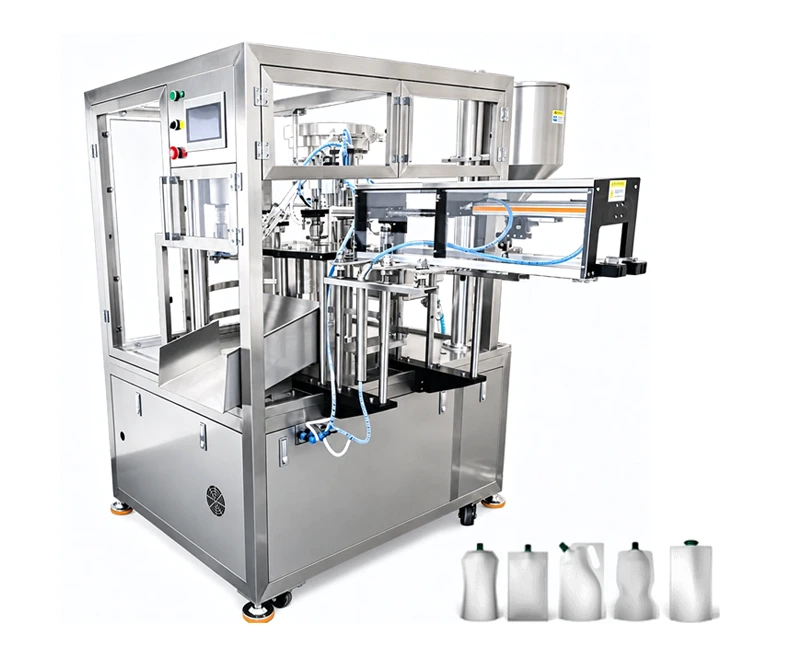
For a buyer who is moving ketchup or another thick sauce to a ready spouted doy-pack pouch for the first time, the main question is not the individual speed of one operation, but the coordination of the entire chain. SPfill combines pouch feeding and positioning, dosing, cap operations, and finished product discharge. This reduces the number of manual transfers between stages, but the configuration still needs to be confirmed based on viscosity, temperature, volume, pump, and number of heads.
Questions covered
- 01
- What process does SPfill link? Automatic feeding and securing of the ready pouch transition to dosing, then to cap preparation, its placement and capping, after which the pouch is discharged from the working area.
- 02
- Why is pouch presence monitoring needed? The photoelectric sensor supports the logic of “no pouch — no dosing.” This helps prevent feeding product into an empty working position and reduces the risk of spillage and subsequent cleanup.
- 03
- What should be checked before ordering? For ketchup and other paste-like products, viscosity, temperature, fill volume and pump type must be matched. The 30–2000 ml range and the stated 30–60 pouches per minute require confirmation for the specific product and format.
1. Pouch feeding: less manual transfer before dosing begins
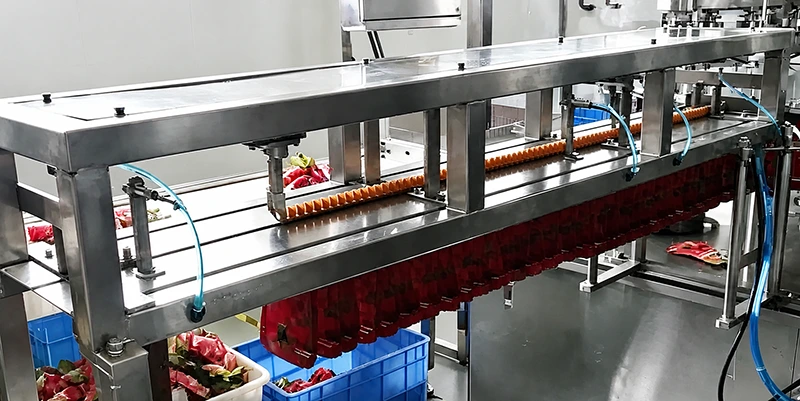
When working with a pre-made spouted doypack, it is important for the operator not just to feed the pouch to the machine, but to ensure a repeatable position of the spout and the fill zone. In the SPfill description, the chain begins with automatic feeding or hanging of the empty pouch, then securing and positioning are performed on the rotary working table. The pouch should not have to be manually passed from one individual operator to the next each time.
This is the first design rationale of the combined machine: feeding, the positioning pocket and the dosing operation are treated as linked stages. The photoelectric sensor monitors pouch presence; if it is absent, product feed is stopped. For a buyer, this means fewer unnecessary actions around each empty package, not a promise of universal operation without adjustment.
2. Dosing: the working position must align with product feed
After securing, the pouch arrives at the dosing operation. SPfill is intended for liquid and paste-like products, including ketchup; the materials also state a fill range of 30–2000 ml and a performance guideline of 30–60 pouches per minute. These values cannot be separated from the product properties: the actual result depends on viscosity and the selected volume.
Second design — alignment of the pouch and filler position. For the project, it is necessary to determine in advance whether a piston or rotary pump is suitable, whether heating or stirring of the hopper is required, and how many heads are needed for the order. The documentation includes options of 2, 4, 8, 10, and 12 heads; therefore, the number of heads should be fixed in the configuration and not assumed to be the same for any ketchup.
3. Cap and discharge: complete the pouch in the same process chain
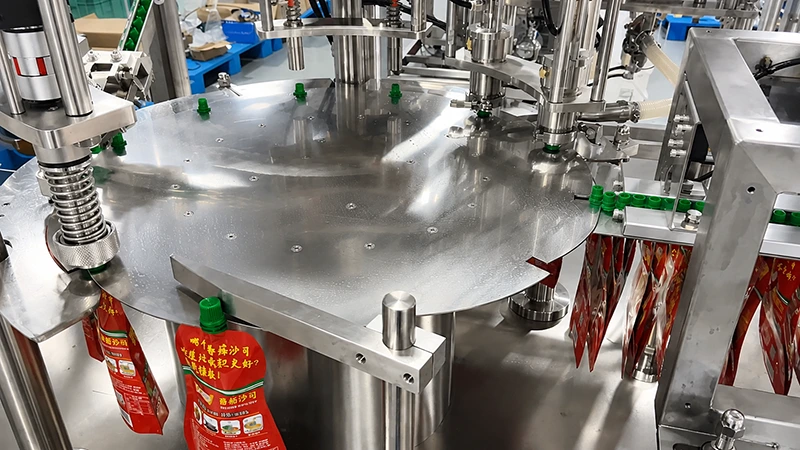
After filling, the pouch should not return to a separate manual flow for each subsequent operation. The described sequence includes cap preparation, cap lifting and feeding, installation on the spout, screw capping, and discharge of the finished pouch. Cleaning of the spout before capping is specified as an option, so its necessity should be discussed together with the product and the selected configuration.
This linkage provides practical value for sauce production: from an empty pouch to a closed product, the path passes through several coordinated positions of the rotary table. At the same time, the materials confirm the discharge of the finished product from the machine, but do not provide grounds to promise automatic placement into boxes or a complete downstream packaging line.
What to specify in a request for SPfill
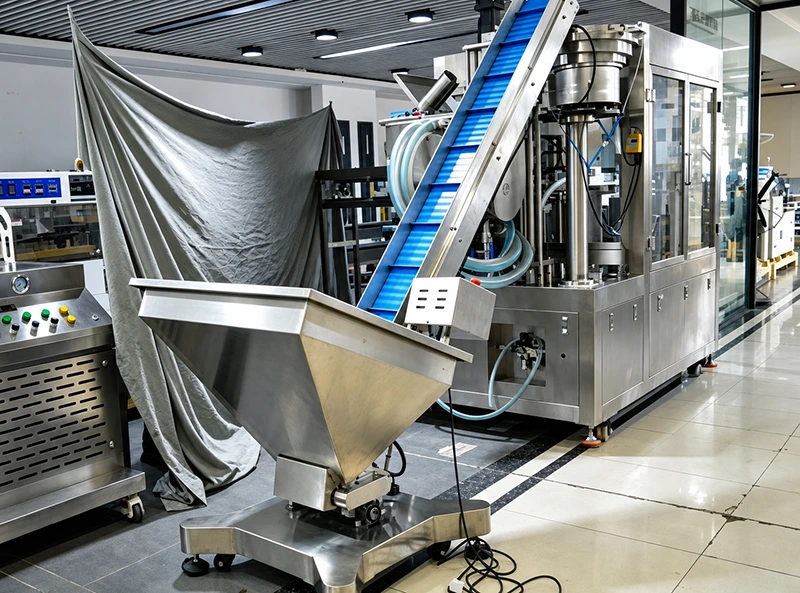
For a first ketchup filling project in a spouted pouch, it is useful to provide the supplier with four initial parameters: the product and its viscosity, temperature, nominal pouch volume, and required number of heads. Additionally, it is necessary to clarify whether hopper heating or stirring is required, the pump selection, the presence of spout cleaning, and the cap format. This way the buyer verifies not only the machine but also whether the working sequence matches their pouch.
SPfill should be considered equipment for filling liquid and paste-like products into ready-made pouches, not as a vertical machine for bulk products, a bottle filling line, or a machine for zip-lock pouches without a spout. For tomato paste and other products with a different viscosity, the solution must be confirmed separately; current materials do not contain a public test report for a specific product.
Application boundary
The materials confirm the sequence of feeding the ready-made pouch, positioning, dosing, cap operations, and discharge. They do not confirm a specific customer, certifications, CIP time, controller brand, complete composition of contact parts, automatic placement into cartons, or the test result for each tomato product. These points should be agreed before ordering.
Discuss the pouch format and SPfill configuration
Provide the type of spouted pouch, the product, volume, viscosity, and required number of heads — this allows a specific discussion of the filling and capping sequence.