
CODAPAK
Filling equipment for ketchup: dynamic filling without stopping containers
With positional filling, the bottle stops under the head, and at each start the sauce splashes. The four-head piston machine fills bottles on the move: the heads move together with them, and servo-driven pistons measure the dose.
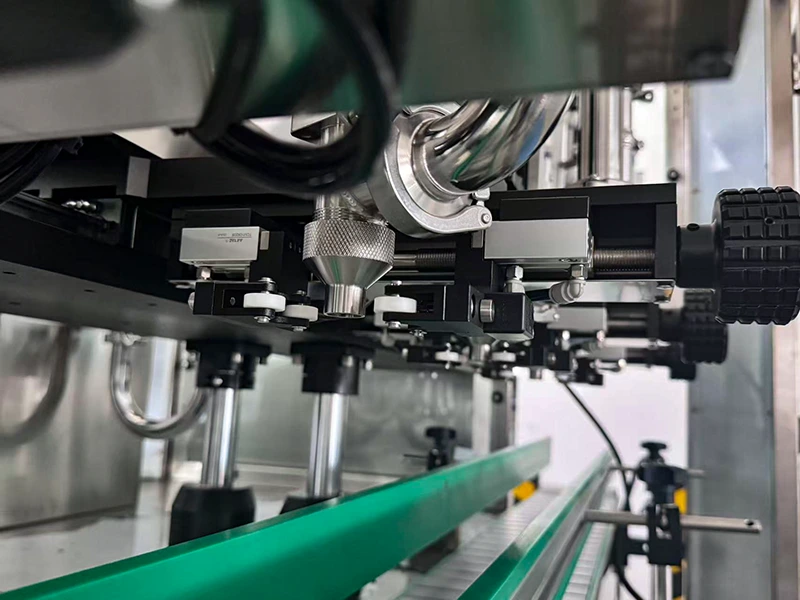
If the bottle stops under each head, the sauce shifts and splashes. Dynamic filling keeps containers moving, so the dosing line does not slow the conveyor at every bottle.
Questions covered
- 01
- How does dynamic filling differ from positional filling? With positional filling, the bottle stands under the head, and at start-up the product shifts and splashes. Here the heads move with the bottle along the path and at the conveyor speed, so containers do not stop. Four heads operate simultaneously.
- 02
- Is the machine suitable for thick ketchup and sauces? The machine is designed for thick, viscous and paste-like products. No viscosity limit is specified in the source material, so each specific ketchup is checked with a trial batch before ordering.
- 03
- What is the volume range and speed? According to the spec sheet, the dose volume ranges from 50 to 1000 ml, and the four-head model runs at 40–50 bottles per minute. Actual output on your line depends on the bottle shape and the product. The materials contain no measurements from real production.
Who needs on-the-fly filling
The filler is designed for producers of tomato ketchup, tomato sauce, and other thick sauces that fill the product into glass or PET bottles. The line must run without frequent pauses.
The machine is installed in a flow where bottles go to capping and labeling after filling. Separate equipment performs these operations.
What disrupts the rhythm in positional filling
In positional filling, the bottle stops under the filling head and starts moving again. The bottle's inertia and the stopping of the flow cause the sauce to shift and splash.
Manual semi-automatic ladle filling remains the older option, in which the volume depends on the operator's work.
The pneumatic piston drive depends on a stable air supply. Pressure fluctuations change the piston stroke and, with it, the dose volume.
How dynamic filling works
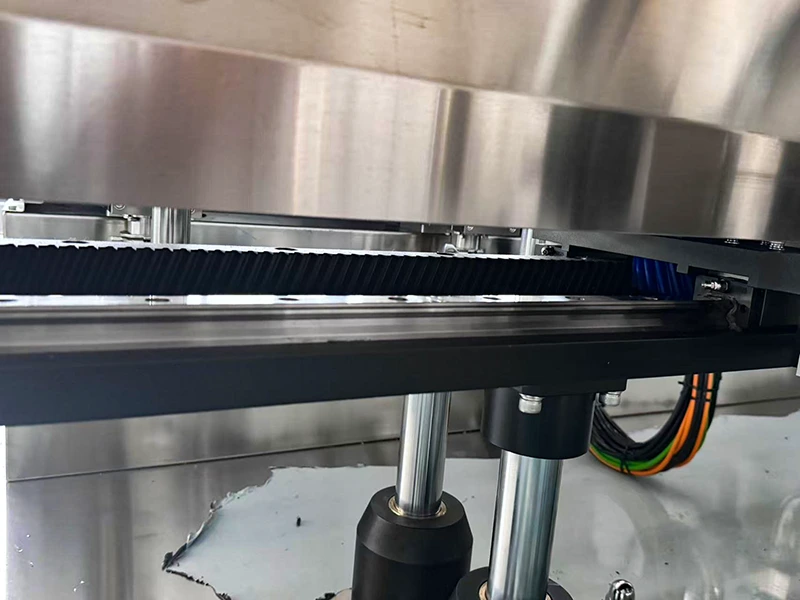
Bottles travel on a slat chain conveyor without stopping. The dosing heads move horizontally along a guide rail and follow the bottles in speed and direction.
A clamp with adjustable jaw spacing holds the bottle neck, and the head lift aligns the nozzle with it. The nozzle is replaceable.
Four pistons are driven by servo motors. The dose volume is set by the number of revolutions and the stroke of the servo motor, not by air pressure as in a pneumatic layout.
Design: what to look for when selecting
The frame and housings are made of 304 stainless steel. The front and rear doors and the electrical cabinet door are glazed with clear tempered glass.
The pipeline is assembled with quick-release clips. A rotary three-way valve switches suction from the hopper to the dosing unit and switches product delivery to the filling head.
The hopper is U-shaped and has a level sensor. When the set level is reached, the feed pump stops.
The line is rinsed with clean or sterile water. Contaminated liquid drains into a collection tank.
Controls and changeover
The operator sets the dose volume and speed on the touch panel. The screen shows the operating status and a counter of filled bottles.
Control is based on 10 servo drives: 4 drive the pistons, 4 move the heads horizontally, 1 adjusts height, and 1 drives the conveyor. The main controller is a PLC.
For a different bottle, adjust the clamps, the head height, and the nylon conveyor guide rails and deflectors. The changeover time is not specified in the materials. Confirm it with the manufacturer.
What the line includes
According to the datasheet for the four-head model: dose volume 50–1000 ml, speed 40–50 bottles per minute, power supply 380 V, 50 Hz. This is the datasheet range; actual output depends on the containers and the product.
The machine sits on swivel casters with support feet for fixing it in place. It is moved around the shop floor on the casters.
Bottles pass through dosing without stopping, and the operator can see the internal components through the transparent doors. Capping and labeling are connected separately.
Application boundary
The speed and volume figures are taken from the datasheet table. Dose accuracy, volume tolerance, viscosity limit, changeover time, CIP cleaning data and gas pressure are neither confirmed nor stated in these materials. The machine does not perform tomato pre-treatment (washing, sorting, concentration) or capping and labeling; these are connected as separate equipment.
Find a configuration to suit your containers
Please specify the product, its viscosity, the volume, and the bottle type. We will check whether the four-head model is suitable and list the data needed to calculate the line.