
CODAPAK
Sauce filling line: one dosing station for different viscosities
One dosing station in a sauce facility operates at more than one viscosity: during a shift, mayonnaise, ketchup, cheese sauce and a thick tomato base pass through it, in glass, PET and tinplate. We examine why the dose drifts when the product and container change and how a piston doser with a three-way valve and heads that follow the container holds it without stopping the bottle.
For a facility where mayonnaise, ketchup and cheese sauce in glass and PET run in one shift, what matters is not the speed of one head but the ability of one dosing station to hold the dose across different viscosities and deliver evenly filled containers to capping without stopping the bottle. A servo-driven piston doser, a three-way valve and heads that follow the container provide exactly this — subject to testing on the specific product and container format.
Questions covered
- 01
- Why the dose drifts when changing sauce: how a servo-driven piston doser differs from a pneumatic one and why the piston stroke does not depend on air pressure in the plant air line.
- 02
- What exactly is readjusted when switching to another jar or bottle: neck gripper, stop, head block height, replaceable nozzle and conveyor stops.
- 03
- Can this station be installed in a line with capping and labeling, and what must be coordinated at the interface: container infeed, the pitch and height of the stops, and the routing of flush discharge during cleaning?
What does a section where sauces vary in viscosity look like?
A sauce section rarely runs on a single product: over a shift, mayonnaise and mayonnaise-based sauces, ketchup and tomato sauces, cheese and cream sauces, and thick dips pass through the dispenser. Their viscosities differ, and the same dose behaves differently: a thick mass fills the neck more slowly, while a liquid one splashes.
The second feature is containers. Glass bottles and jars, PET, and tin cans coexist on the same floor, which means they differ in neck diameter, height, and body diameter: each format requires its own setting for the gripper and stop.
The third is continuity. The filling section sits between the mixing department and capping, so stopping a bottle under the nozzle slows the pace of the entire line, not just the dispenser.
Therefore, the section is built around a single dosing station that handles the entire sauce range and common container formats, instead of a separate machine for each product. This is the task for which a filling line for thick products is designed.
Why older setups result in inconsistent dosing and downtime
Semi-automatic filling with a ladle or manual dispenser relies on the operator: both the dose and the pace depend on them. With a thick sauce, the variation between jars is immediately visible, and any pause stops the flow.
Positional filling with container stop looks more precise, but it is precisely this that causes agitation and splashing: the bottle stops, filling takes place, then the bottle starts moving — on start-up the product sloshes and escapes through the neck. This results in dirty containers and wiping at the outlet.
A pneumatic piston dispenser depends on air pressure in the shop line: a pressure drop changes piston stroke, and the dose drifts from jar to jar — unstable dosing that is noticed already in the finished goods warehouse.
A machine assembled for one sauce handles a second poorly: with a different viscosity, units must be readjusted and nozzles changed; with a different jar format, stops and gripper must be repositioned, and a product change turns into downtime.
What maintains the dose when switching from mayonnaise to ketchup
The basis is a piston dispenser: the cylinder of the piston pump simultaneously serves as a metering chamber. First the product is drawn into the cylinder, then pushed into the container, so the volume is set by piston stroke, not by outflow time — thick and liquid masses are dosed according to the same scheme, and no separate setting for each medium-viscosity sauce is needed.
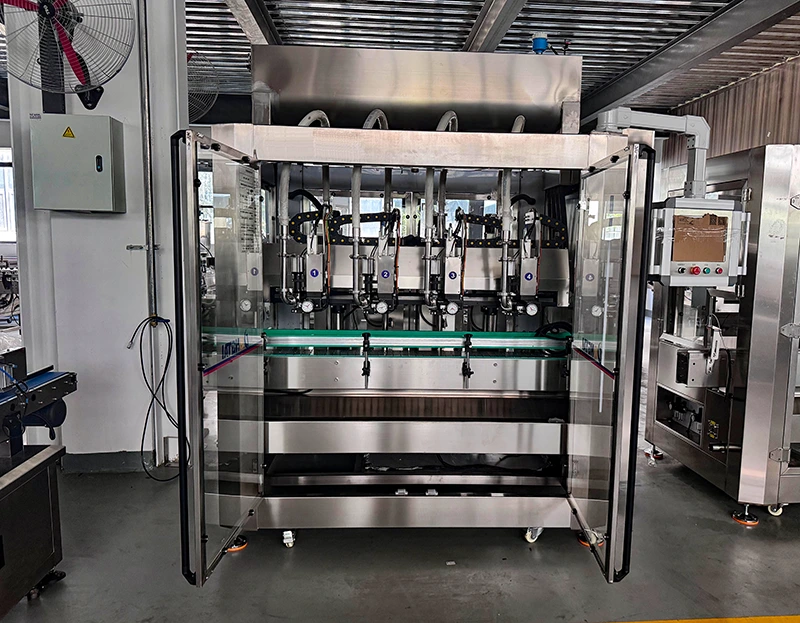
Air has been replaced by a servo drive: each of the four piston pumps is driven by a separate servo motor with adjustable speed and number of revolutions. Unlike pneumatics, the stroke is not tied to line pressure — so the dose does not drift when air pressure drops.
A three-way rotary valve separates two phases: on suction, “hopper — metering chamber”; on discharge, “metering chamber — filling valve.” The product does not flow by gravity, so viscosity has less effect on filling, and the path remains closed from hopper to nozzle.
The four heads follow the container: while the bottle moves along the slat conveyor, the heads move synchronously toward it and at its speed — along a helical rack, via a servo motor with a gear and along a linear guide. Replaceable filling nozzles and an adjustable neck gripper cover the difference in formats.
Changeover to another format and flushing of the product path
When switching to a different jar or bottle, four assemblies are readjusted: the gripper with adjustable distance between the jaws, the adjustable stop, the lifting of the head block on a pneumatic cylinder, and the replaceable filling nozzle. On the conveyor, the height and pitch of the blue plastic stops are adjusted separately.
Changeover time is not given in the open materials, so it has to be measured on your own containers: this point is clarified at the selection stage together with the neck format.
The product path is assembled on quick-release clamps: the pipes from the U-shaped hopper to the piston pumps are removed without tools, and the flushing valve drains product residues from the hopper into a separate vessel with a side outlet. Flushing is done with clean or sterile water.
The process can be watched without opening the doors: transparent tempered glass panels at the front and rear plus a transparent electrical cabinet door show the metering cylinders and the operation of the assemblies in motion, and the level sensor in the hopper automatically stops the feed pump when the threshold is reached — without overflow and without unnecessary stops.
How the filling section interfaces with capping, labeling and the conveyor
The interface with the conveyor is handled inside the machine: a slat-chain conveyor is built into the 304 stainless steel frame, container feed is automatic, and at the outlet of the section the bottle moves to the next module under its own power, without manual transfer. Therefore the filling section behaves as a standalone module of packaging equipment, not as an attachment to a table.
Capping and labeling are adjacent operations, not parts of this machine. The capping (seaming) machine and the labeler are installed in the line after filling, and their speed is matched to the dosing speed, not the other way around.
The integrator must agree on four things: the pitch and height of the stops on the conveyor, the height position of the head block, the neck format for gripping and the nozzle type, and the location of the washing discharge outlet.
Result for the section: continuous feed and stable dosing across the entire sauce range, less splashing and fewer rejects at the output, washing and changeover without dismantling the product path, and the next module receives precisely filled containers at a predictable rate. Specific viscosity, rate, and dosing accuracy are confirmed at the selection stage based on a product and container sample.
Application boundary
Viscosity range, dosing accuracy, capacity, supply voltage and power consumption, air pressure, dimensions and weight are not confirmed in publicly available materials and are clarified upon request. The suitability of a specific product, container format, and capping interface is checked at the selection stage — using a product sample, container sample, and description of the section. Changeover time and washing parameters are set based on actual conditions on the specific line.
Select a dosing unit for your sauce range
Describe the products that run per shift, the container formats, and what is installed after filling. We will check them against the station configuration and come back with refined parameters for your case.