
CODAPAK
Tomato paste filling line: dispenser for viscous products
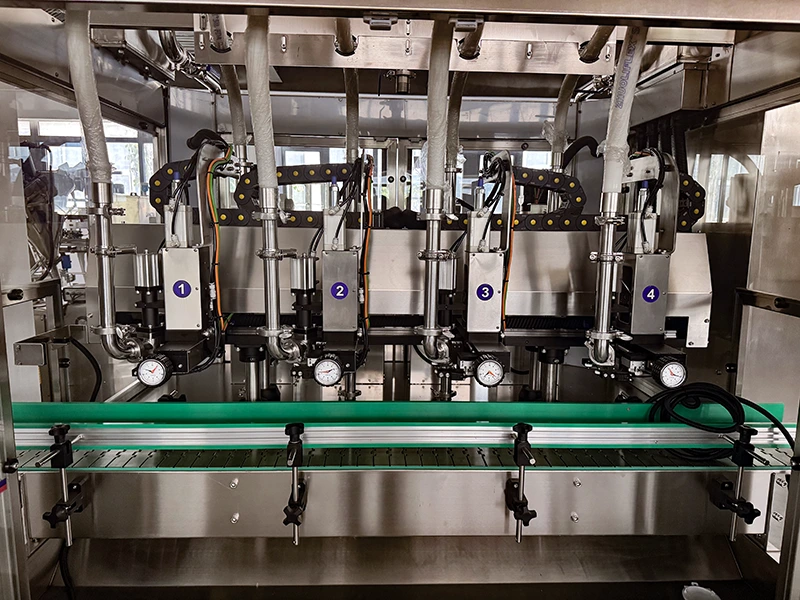
Tomato paste is a thick, high-viscosity product: when the container stops at the filling position, the mass is agitated, splashing occurs, and the dose becomes unstable. Below is how a filling line for thick and pasty products with piston dosing and fill-in-motion works: four heads travel with the container, and the volume is set by piston servo motors rather than air pressure.
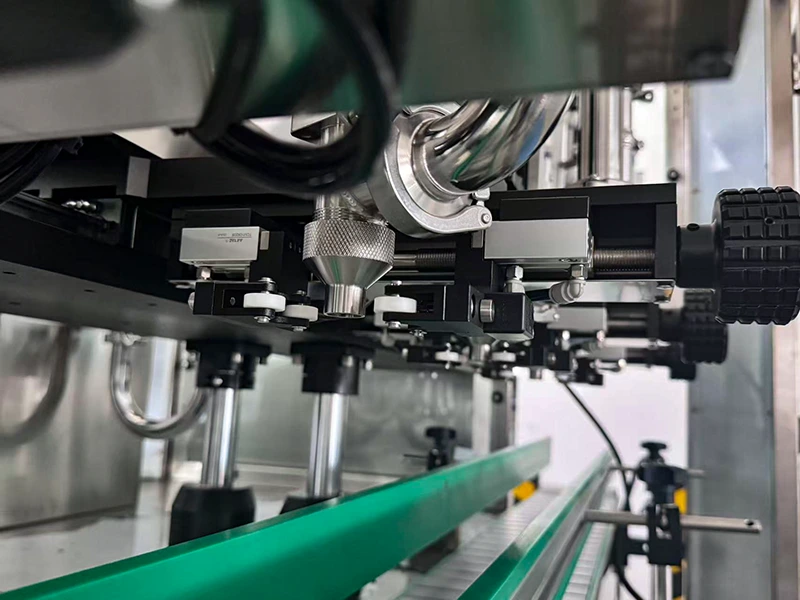
On tomato paste, what matters is not a single unit but the combination: a metering cylinder with a servo drive, a three-way valve and filling without stopping the container. That is what delivers a stable dose and eliminates splashing on a thick product.
Questions covered
- 01
- Why does splashing occur on tomato paste and how is it eliminated?
- 02
- How does a piston dispenser with a servo drive differ from a pneumatic one?
- 03
- Can a filling unit be integrated into an existing line before capping?
- 04
- How do you maintain and clean the circuit after a thick product?
Where this is needed: filling tomato paste into glass and PET containers
A typical scenario is a tomato processing shop: paste, concentrated paste, purée and sauces go into glass jars, tin cans or PET containers. Such a section operates as sauce and tomato product packaging and must interface with capping, labeling and container transport between stations.
The second scenario is turnkey line assembly: the filling unit is integrated between container infeed and the capping machine without breaking the flow. That is why a filling line for thick and pasty products is assessed not by an individual unit, but by whether it maintains continuous infeed.
The third scenario is a small production that has grown out of semi-automatic packaging and manual ladle filling: manual labor and dose variation became a constraint, and output volume already requires a machine with metered dosing and a clear sanitary design.
What does not work with a thick product: container stoppage and dosing “on air”
Semi-automatic machine and manual filling. The operator scoops product with a ladle and pours it into the jar: the dose depends on the person, not on the unit, and with thick paste the variation is especially noticeable — some jars go to rework.
Positional filling. The container stops under the nozzle and then starts again. With paste, starting and braking agitate the product and cause splashing over the edge, and the level in the jar varies from cycle to cycle.
Dosing by air pressure. The pneumatic piston is driven by line pressure: pressure fluctuations change the stroke, and the dose drifts with the stroke. Gravity and peristaltic volumetric dispensers behave the same way with inconsistent viscosity — the dose is unstable.
The result is the same for all three schemes: unstable dosing, downtime for adjustment, and more rejects. What needs to change is not the settings but the filling scheme.
Piston dispenser for viscous products: volume is metered in the cylinder
The measuring chamber here is the dosing cylinder with the piston itself. First the piston draws product from the hopper and takes in the dose, then pushes the metered volume through the filling nozzle into the container. That is, taking in and delivering the volume are separated in time and do not depend on how fast the container moves.
Flows are switched by a three-way rotary valve: one position is 'hopper — measuring cylinder', the second is 'measuring cylinder — filling valve'. This valve separates dose intake from delivery, so the thick mass does not 'catch up' with the jar under gravity.
The pistons are driven by servo motors, not pneumatics: stroke and volume are set by the number of revolutions and speed, so the dose does not depend on pressure fluctuations in the pneumatic line. Pneumatics are responsible only for opening valves, lifting heads, and clamping containers; the air passes through a preparation unit.
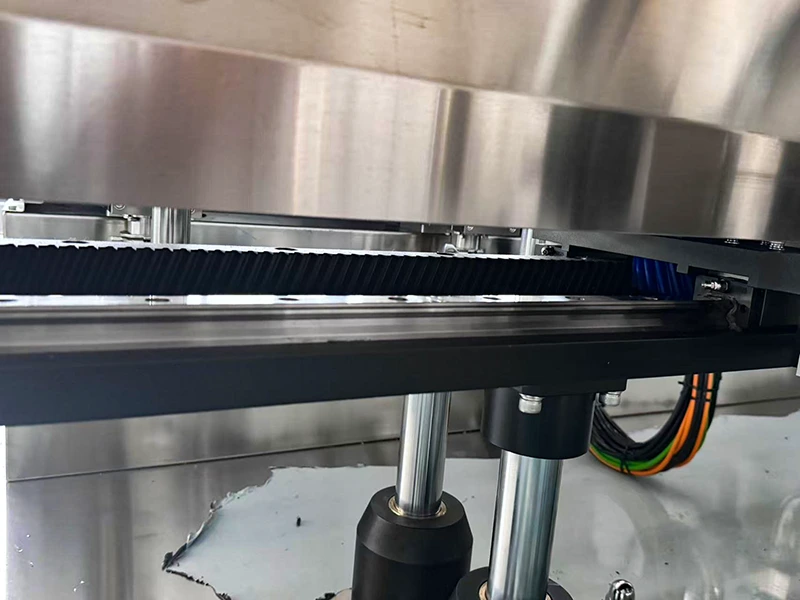
Filling takes place in motion: the container does not stop, and the heads move with it along guides — a helical rack, a servo motor gear, and linear guides; the heads operate in pairs or individually. As a result, the product surface does not ripple, and splashing and agitation are eliminated.
Cleaning and sanitation: what is disassembled after a thick product
Paste remains in the pipelines and valves, so on such a line not only dosing matters but also how the unit is cleaned. The circuit is assembled with quick-release clamps: branches are removed without tools, and valve assemblies are accessible without dismantling the frame.
For flushing, clean or prepared water is passed through the circuit; residues from the metering section are discharged by the flushing valve. Drainage from the tray is collected in a separate container and drained from the side, without spreading across the workshop floor.
External hygiene is part of the design, not an option: a 304 stainless steel frame, transparent tempered glass doors at the front, rear and on the control cabinet, and a protective guard covering moving parts during operation.
The cleaning procedure and time for a specific product are not confirmed in open materials — they are specified during selection.
Result in the line: continuous supply, stable dosing, fewer rejects
Containers move continuously along a chain plate conveyor; adjustable-height, adjustable-pitch side guides keep them in the lane. Product is fed from the receiving hopper, and a sensor monitors the level: when the threshold is reached, the feed pump stops — no overflow and no unnecessary downtime.
Settings are on a touchscreen: fill volume and speed are set from the panel, which also shows operating status and a filled-container counter. The electricals are housed in a cabinet with a transparent door: controller, frequency converters, power supplies, relays, circuit breakers and terminals.
What this delivers on tomato paste: continuous feed without container stops, stable volumetric dosing and less splashing — hence fewer rejects and fewer reworks at the line output.
The unit moves on wheels, and the working position is secured with supports. Specific values for fill volume, rate, dosing accuracy and dimensions are confirmed on request.
Application boundary
Data boundaries: the fill volume range, output in containers per minute, dosing accuracy, operating viscosity range, voltage and power, air pressure in the pneumatic line, and machine dimensions and weight are not confirmed in publicly available materials and are clarified on request during selection. Parameters of other sizes in the series do not carry over to this machine. Compatibility with a specific paste, container and product temperature is verified using a sample.
Test filling with your paste
Send us the product viscosity and temperature, container type and size, required volume per jar and desired line rate — we will select the filling unit configuration and confirm the parameters.