
CODAPAK
Thick sauce filling line: why the container should not stop at every dose
On a thick product filling line, every container stop results in a surge of product in the bottle and an unstable level. FTPfill is a four-head piston filler with tracking: the heads move in sync with the bottle on the chain conveyor and do not stop the flow. Below is what components make up such a filling line and which points to check before purchase.
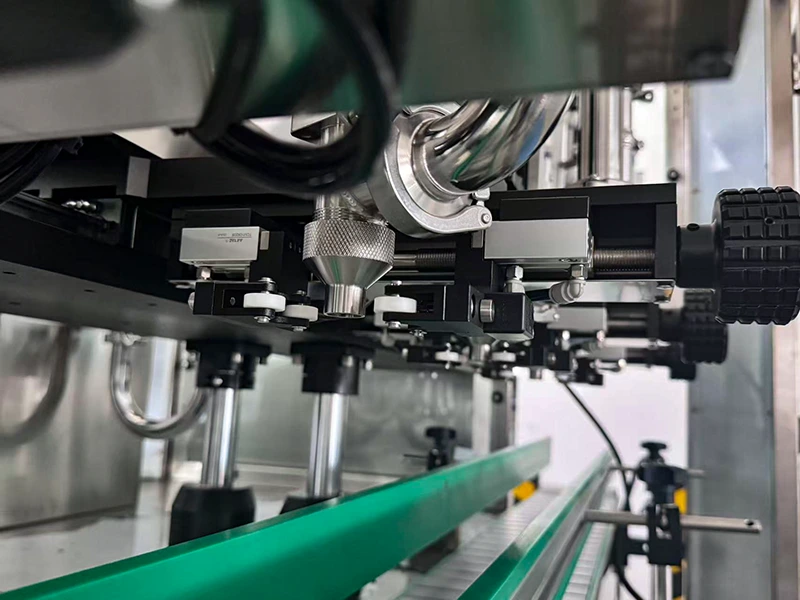
If thick sauce splashes on your filling line and the dose varies from bottle to bottle, the cause is usually not the recipe but two design decisions: stopping the container at every dose and a pneumatic piston drive. A design with container tracking and servo-driven pistons removes both of these limitations at the mechanical level.
Questions covered
- 01
- Why should the container not be stopped at every dose on a filling line for thick products?
- 02
- How does a servo-driven piston dispenser differ from a pneumatic one in dose stability?
- 03
- What needs to be readjusted when changing the bottle type on such a dispenser?
- 04
- Which components should be checked for cleaning and maintenance on a viscous product filling line?
Where a thick-product filling line runs into limits
This refers to production where ketchup, tomato sauce, tomato paste, as well as thick and viscous food products such as sauces, honey or gel, are filled into glass or PET containers. The dose volume here usually ranges from 50 to 1000 ml, and containers move along the conveyor in a continuous flow.
It is precisely the continuity of flow that becomes the bottleneck: the thicker the product, the more sensitive it is to any acceleration or deceleration of the bottle at the filling position.
What happens when the bottle stops at every dose
Classic indexing filling works like this: the container moves in, stops, the head fills, and the container starts moving again. With a viscous product, starting and braking create inertial movement — the surface in the bottle sloshes, the product splashes, and the level after filling ends up uneven.
The second source of instability is the piston drive. In the pneumatic version, the piston stroke depends on the pressure in the compressed-air line, and fluctuations in supply shift the actual dose volume. With a thick product, this difference is noticeable to the eye from the level in the bottle.
Hence the typical consequences for the shop floor: drips on the neck and conveyor, manual adjustment of volume, rework, and an inconsistent batch at output.
How tracking works: the heads move together with the container
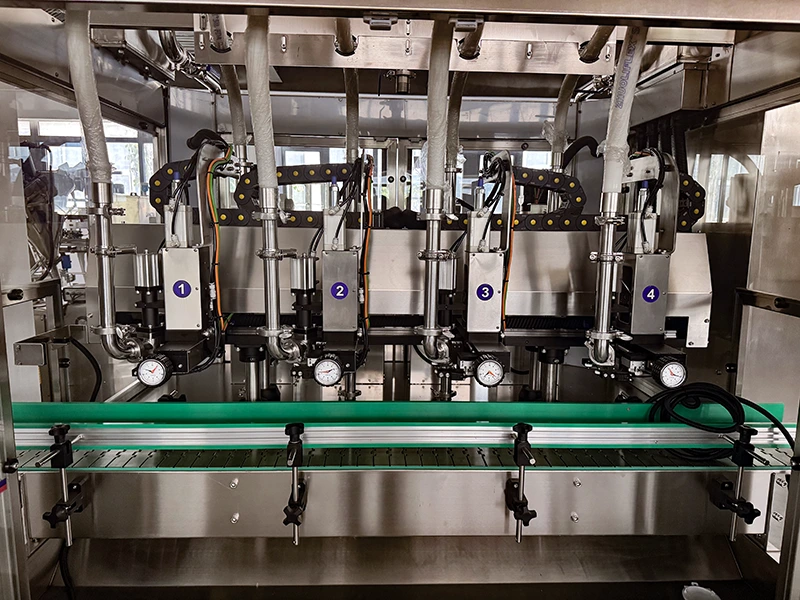
On the FTPfill, the heads do not wait for containers at the position. Four filling units move horizontally following the bottle at the same speed set by the chain conveyor, and filling takes place on the move. According to the description of the unit's operation, the product surface remains calm, without agitation or splashing.
The horizontal movement is built on a helical rack, a servo motor with a pinion and linear guides. The four heads can operate in pairs or individually, which allows flexible distribution of the container flow.
Alignment accuracy is ensured not only by the electronics. A clamp holds the bottle by the neck, adjustable stops position the containers at the pitch, and the head is lowered by a pneumatic cylinder so that the nozzle and the neck align on the same axis.
Dosing and control: servo drives instead of compressed air
Each of the four piston pumps is driven by a servo motor: the volume is set by the number of revolutions and monitored during the stroke, rather than by pressure in the pneumatic line. A three-way rotary valve switches the cycle — drawing product from the hopper into the metering chamber and dispensing through the filling valve.
The machine has ten servo drives in total: four drive the piston pumps, four move the heads horizontally, one is responsible for the height of the entire head frame and one for the chain conveyor. Control is built on a PLC, with frequency converters, a power supply, relays, circuit breakers and terminal blocks also installed.
The operator sets the dose volume and filling speed on the touch screen, which also shows the machine status and the number of bottles already filled. For the four-head version, the specification lists a dose of 50-1000 ml (with custom versions available), a capacity of 40-50 bottles per minute, 380 V / 50 Hz power supply, 4.5 kW power, dimensions of 2200x1400x2200 mm, and a weight of 700 kg. Values for the two- and six-head versions are given in the specification only for series comparison.
Bottle changeover, cleaning, and component monitoring
When switching to different containers, not the entire machine is adjusted, but specific points: the clamp arrangement for the neck, the height and pitch of the adjustable stops, the overall height of the head block, and, if necessary, the filling nozzles are replaced. The manufacturer claims adaptive positioning by neck, but changeover time is not specified in the documents, so it is worth measuring during acceptance testing with your own containers.
For cleaning, the circuit is assembled with quick-release clamps: the pipelines can be removed without disassembling the frame, the cleaning valve drains residues from the hopper into the tray, and the tray drains from the side. This is important specifically for thick products that linger in valves and elbows.
The operation can be observed without opening the machine: transparent tempered glass doors are on the front, rear, and electrical cabinet, and the frame and main components are made of 304 stainless steel. The electrical cabinet is cooled by fans on the sides, and pneumatic tubes are routed in a protective chain.
What production ultimately gets
The filling line no longer runs in start-stop mode: containers move along the chain conveyor without stopping for the dose, and the heads catch up with them synchronously. Fewer jolts in the bottle — fewer drips and less manual volume adjustment.
The layout is built on a single 304 stainless steel frame: hopper on top, dosing block with four heads, built-in conveyor, control panel and electrical cabinet. Swivel casters are provided for moving it around the shop floor, and support feet for operating in place.
Downstream there is usually capping and other operations — these are separate machines in the line, not functions of this dispenser.
Application boundary
What this machine does not do and what we do not claim. FTPfill is a filler for filling thick and viscous products; it is not primary tomato processing equipment (harvesting, washing, sorting, crushing, pulping, vacuum evaporation, pasteurization), it is not a packaging machine for bags and it is not a labeller. The capping machine mentioned in the line description is an adjacent operation after filling, not a characteristic of the filler. We do not provide data on dosing accuracy, maximum viscosity, changeover time, cleaning parameters and certification, since they are not confirmed in the current materials. Suitability for a specific product and container is confirmed separately.
Check the filling line for your product
Send us the product type, dose volume and container format — we will select the dispenser configuration and show which components will require adjustment for your product range.