
CODAPAK
Sauce packaging machine: four-head filling without stopping containers
Why it is better not to stop containers under the nozzle when filling thick sauces: the FTPfill four-head machine carries the bottle along the conveyor and doses with servo-driven piston pumps. We break down the design, the parameters of the four-head version and the adjustment points when changing containers.
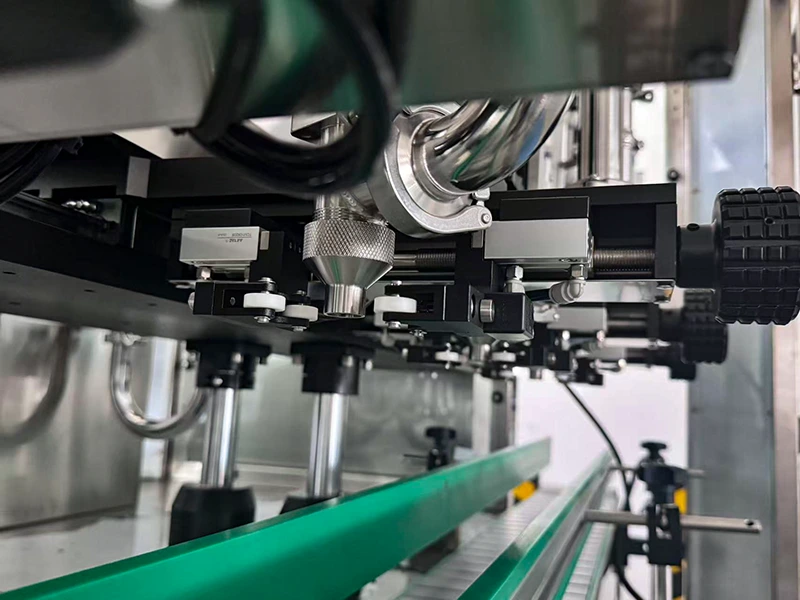
If your workshop runs thick sauces, ketchup or tomato paste, and the containers are glass or PET, tracking four-head filling removes the main cause of splashing: containers are no longer stopped under the nozzle. The servo drive of the piston pumps holds the dose regardless of air pressure in the line, and quick-release piping shortens disassembly during washing. The configuration is selected after testing on your product and your container.
Questions covered
- 01
- Why are containers not stopped under the nozzle when filling thick sauce?
- 02
- What fill volume and throughput does the four-head FTPfill version have?
- 03
- What needs to be reconfigured when switching to a different bottle?
- 04
- How is the product circuit flushed after a thick sauce?
- 05
- Is the machine suitable for ketchup, tomato paste and honey?
Where the old sauce filling scheme fails
Positional filling stops the bottle under each nozzle. During start-up and braking, the product in the container is pushed forward, the sauce sloshes and gets onto the neck and thread — instead of a level fill, the result is contaminated containers and extra rework.
A purely pneumatic plunger depends on line pressure: air fluctuations change the piston stroke, and the dose drifts with it. For a thick sauce made from expensive raw materials, this means direct product losses.
Thick product drains poorly from pipes, valves and metering vessels. If the piping cannot be quickly disassembled, cleaning between batches drags on and requires manual work.
When operating in a closed enclosure, the internal state is not visible: to understand what is happening with the flow and nozzle, you have to open the door while the line is running.
What tracking filling delivers: the container travels and the heads move with it
In FTPfill, the bottle does not stop under the nozzle. Four heads move horizontally at conveyor speed and fill containers on the move, so starting and braking of the product in the bottle are eliminated by the filling design itself.
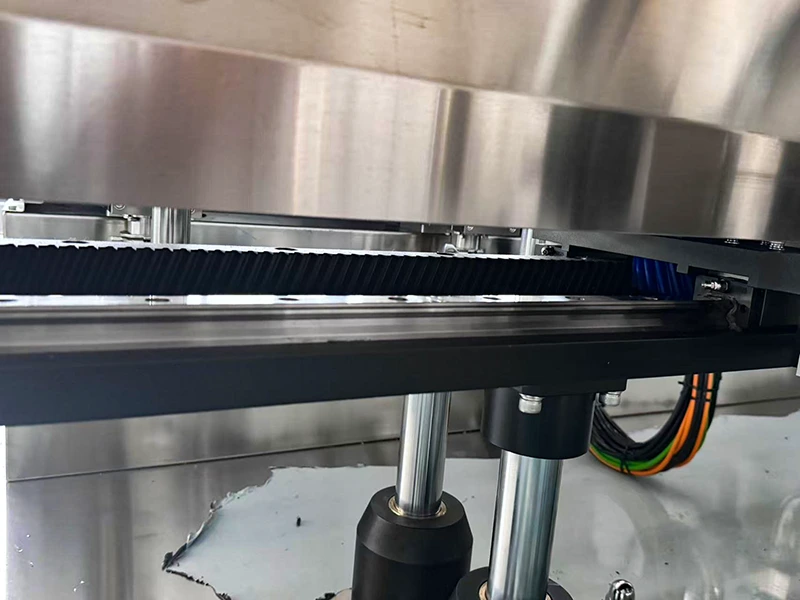
Horizontal movement is based on a helical rack, a gear on a servo motor and linear guides. The heads can operate in pairs or individually, and the head frame is raised by a separate drive to the container height.
Before filling, the bottle is secured by a clamp with adjustable distance between the jaws, and the head is lowered onto the neck so that the nozzle and neck are on the same axis. According to the manufacturer's video, with the tracking configuration the product surface remains calm, without a wave or splash at the neck.
Containers are fed by a slat conveyor with blue nylon strips; the pitch and height of the strips can be changed to suit bottle diameter and height.
Dosing: plunger pump, three-way valve and ten servo drives
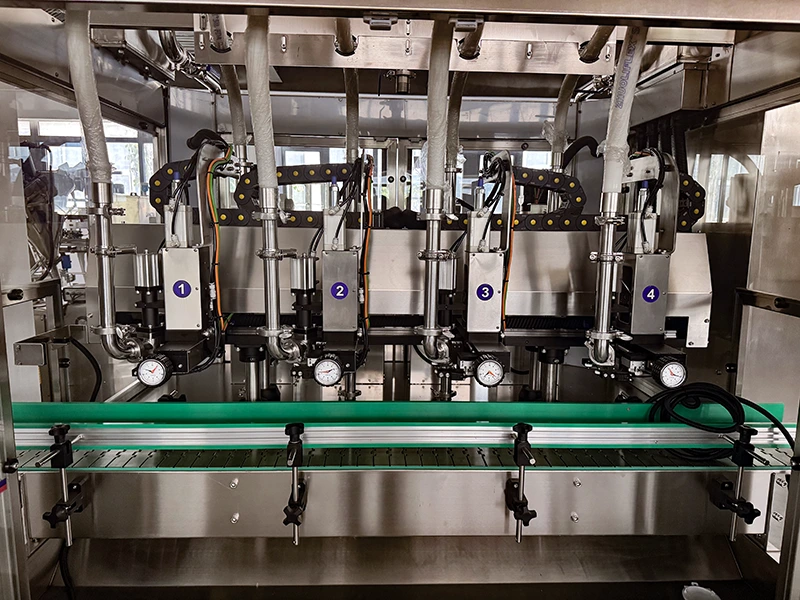
Each of the four plunger pumps runs through a suction — dose — discharge cycle: the pump sleeve also serves as the measuring chamber, and a three-way rotary valve switches the flow from the hopper to the measuring chamber and then to the nozzle.
The dose is set by servo motors: the stroke is determined by speed and the number of revolutions, not by air pressure. Four drives run the plunger pumps, four drive the horizontal movement of the heads, and two more drive the frame height and the slat conveyor; the logic is controlled by a PLC controller.
The product comes from the U-shaped hopper through two stainless steel lines. A level sensor monitors the fill: when the threshold is reached, the feed pump stops, so there is no overflow and the machine does not run idle.
The pneumatics are set up separately from the product circuit: compressed air passes through an air preparation unit to open the nozzle valves, raise the heads and drive the clamps, and the hoses are routed in a protective chain tray.
Specifications of the four-head FTPfill version
Dose from 50 to 1000 ml; a version for a different volume is agreed separately. Power supply 380 V / 50 Hz, power 4.5 kW, dimensions 2200×1400×2200 mm, weight 700 kg.
The output of the four heads according to the manufacturer's table is 40–50 bottles per minute. This is the rated figure for the series, not a measurement result on a specific sauce and a specific container: the actual rate depends on the dose, product viscosity and feed stability.
The same series includes 2- and 6-head versions — 20–40 and 70–120 bottles per minute. Their values are given only for comparison when choosing a size and are not parameters of the four-head machine.
The air pressure in the data sheet is given with distorted figures, so it is not carried over into the technical specification without separate confirmation.
Container changeover and maintenance: five adjustment points
When switching to a different bottle, the distance between the clamp jaws, the height and pitch of the guide rails, and the height position of the heads are adjusted; the nozzle is replaced if necessary. These units are adjustable by design, but the specific changeover time is not confirmed in the materials.
The product lines are mounted on quick-release latches; there is a flushing valve and a water drain box — the circuit is flushed with water or harmless water without fully disassembling the piping. Parameters and results of CIP cleaning are not provided in the supplied materials.
The condition of the components is visible through transparent tempered-glass doors at the front, rear and on the cabinet; these doors also protect personnel from moving parts. The control cabinet is cooled by fans on both sides, and its door is transparent.
The dose and filling speed are set on the touch panel, which also displays the current machine status and the number of filled bottles — separate start, stop and emergency stop buttons are located on the panel housing. Swivel casters are provided for moving around the shop floor, and support cups for the operating position.
Application boundary
FTPfill is a sauce filling and packaging machine, not a tomato raw material preparation line: washing, sorting, crushing, pulping, boiling down and aseptic storage are not part of its scope. The capping machine, labeler and transport container packer are separate line operations. Dose accuracy, maximum product viscosity, changeover time, CIP parameters, certificates and warranty are not confirmed in the supplied materials; suitability for your sauce, feed temperature and container type is checked on samples.
Test filling with your sauce
Send us the product, its viscosity and temperature, the dose volume and container type — we will select a configuration for your line, agree the dose and test filling on samples.