
CODAPAK
Sauce packaging machine: how in-motion filling maintains a consistent ketchup level
FTPfill is a four-head in-motion filling machine for thick sauces: containers move along the conveyor without stopping, and the fill volume is set by the servo drive of the piston pumps. We examine what this provides when filling ketchup and tomato sauces into glass and PET containers.
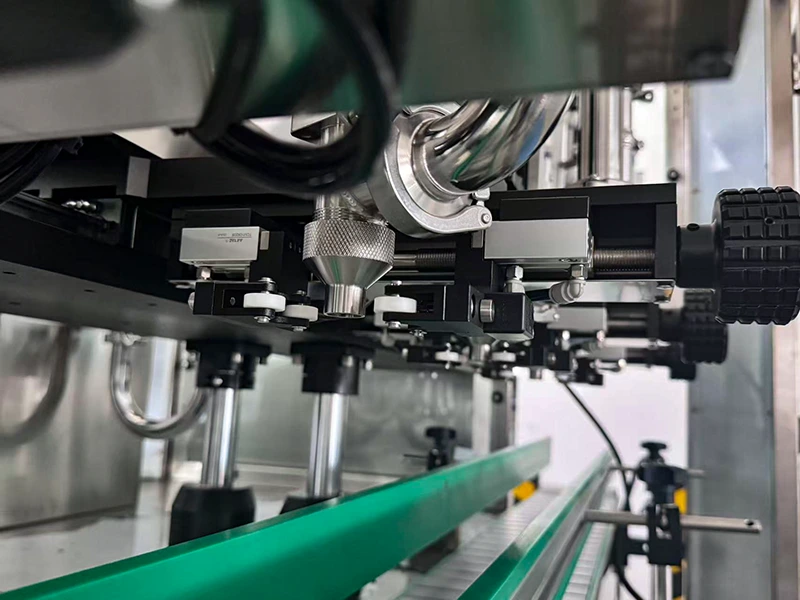
For ketchup and tomato sauces, not only filling speed but also volume consistency matters: in FTPfill, containers do not stop, four piston pumps are driven by servo motors rather than air pressure, so volume is set by rotation speed rather than the state of the pneumatic system.
Questions covered
- 01
- Why is in-motion filling preferable to indexing filling with a bottle stop when filling thick ketchup?
- 02
- How does the four-head servo-driven piston filler affect fill volume repeatability?
- 03
- How is the FTPfill product path arranged, and how are its washing and contaminated water drainage handled?
- 04
- What does the operator adjust from the panel, and what can be observed through the protective doors?
Why does a filling line for thick products dislike container stops?
In positional filling, the bottle stops under the filler, then starts again. For thick ketchup, this is an extra jolt: the product in the container sways, and the surface does not have time to settle before the next operation.
FTPfill operates on a tracking principle: containers move continuously along the slat conveyor, and four filling heads move together with the bottle in its direction of travel and fill it on the move.
According to the manufacturer's materials, this mode produces an even product surface without splashing or agitation — this is critical for ketchup, tomato sauce, and other viscous products.
Four pistons: suction, dosing, and discharge cycle
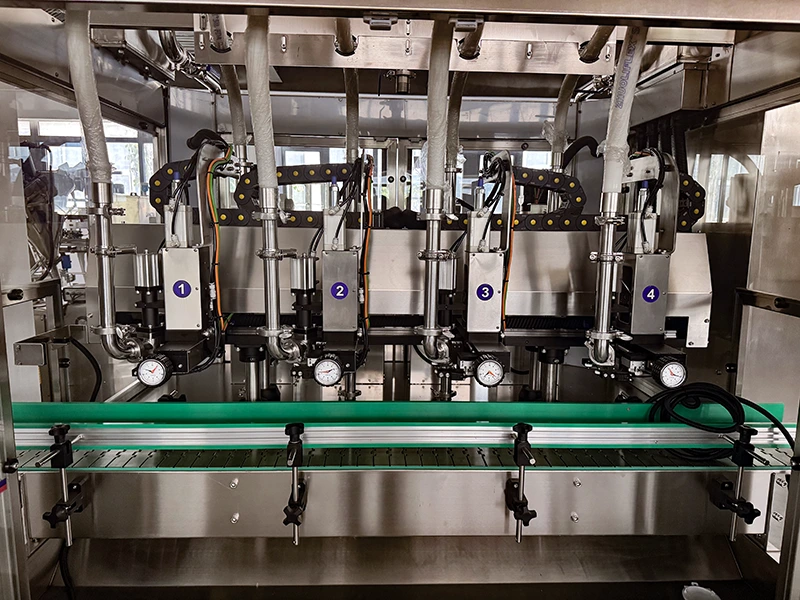
The FTPfill dosing unit consists of four piston pumps. The housing of each piston also serves as a metering chamber: first the product is drawn in at a set volume, then discharged into the bottle.
Flow switching is performed by a three-way rotary valve: one position is “hopper to metering chamber,” the other is “metering chamber to filling valve.”
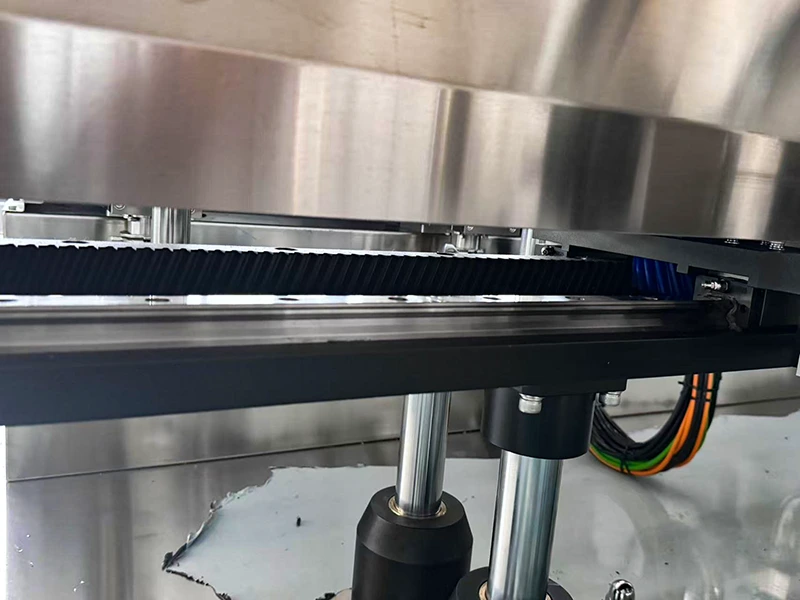
The heads move along a toothed rack with a servo motor and linear guide; during operation they can be paired or move separately, and the filling nozzles are interchangeable.
Why a piston dosing unit is powered by a servo drive rather than compressed air
If the piston stroke is set pneumatically, it depends on the pressure in the line: air fluctuations change the stroke and, with it, the actual fill volume. For ketchup, such instability means different weights in bottles from the same batch.
In FTPfill, four piston pumps are driven by servo motors: the volume is set by the number of revolutions and speed, not by air pressure.
In total, the machine has ten servo amplifiers: four for the piston pumps, four for horizontal movement of the heads, one for frame height, and one for the slat conveyor. A PLC controller controls everything; a frequency converter, power supply, relays, and circuit breakers are installed separately.
Product path, washing, and draining: what matters in sauce production
The product path is assembled with quick-release latches, and the filling nozzles are replaceable — this simplifies disassembly and selection for different types of bottles and sauces.
For washing, water or sterile water is run through the pipelines; contaminated water is collected in a separate tank and discharged from the side of the machine.
The U-shaped hopper is equipped with a level sensor: when the control value is reached, the feed pump stops — this reduces the risk of overflow and downtime. The 304 stainless steel frame and transparent tempered doors are designed for hygiene in a food production area.
What is set from the operator panel and what is visible through the protective doors
The touchscreen is used to set the fill volume and speed and to view the current machine status and the number of bottles already filled.
Transparent tempered doors at the front, rear, and on the electrical cabinet allow observation of the components while in operation, without stopping the line. The pneumatics — filling valves, head lifting, bottle holders — are supplied through an air preparation unit with a filter.
What to clarify before selecting a machine for your ketchup
The series is described in three versions by number of heads — 2, 4, and 6. FTPfill is the four-head version; values for the other versions are provided only for series comparison and are not specifications of this machine.
For the four-head version, the specification states a fill volume of 50–1000 ml (with possible modification), a speed of 40–50 bottles per minute, power supply 380 V / 50 Hz, power 4.5 kW, dimensions 2200×1400×2200 mm, and weight 700 kg.
Suitability for a specific ketchup and container is confirmed using a product sample: viscosity, feed temperature, and bottle type are checked separately for each case.
Application boundary
The article describes only the FTPfill specifications confirmed by the source. We do not provide dosing accuracy, the upper viscosity limit, changeover time, washing or CIP parameters, actual performance data, or air pressure: these values are either unconfirmed or distorted in the source document. Values for the 2- and 6-head versions are provided only for series comparison. FTPfill is not tomato pretreatment equipment (receiving, washing, sorting, crushing, pulping, evaporation, pasteurization), a vertical packaging or sachet machine, or a capping or labeling machine — capping and labeling belong to subsequent operations of the line.
Select a machine for your sauce
Describe the product, container, and required fill volume — we will clarify the FTPfill configuration and operating mode for your ketchup or tomato sauce.