
CODAPAK
Sauce filling equipment: how to choose a machine for your own containers
Sauce and paste-like product plants work with several recipes at once — from free-flowing to thick and viscous — and with different containers: glass, PET, jars, bottles with different neck sizes. That is why choosing sauce filling equipment starts not with a throughput figure, but with the dosing method, the fit to the container and the sanitary design. We break down what a piston dispenser with a three-way valve, four-head container follow-through and dismountable stainless steel piping provide.
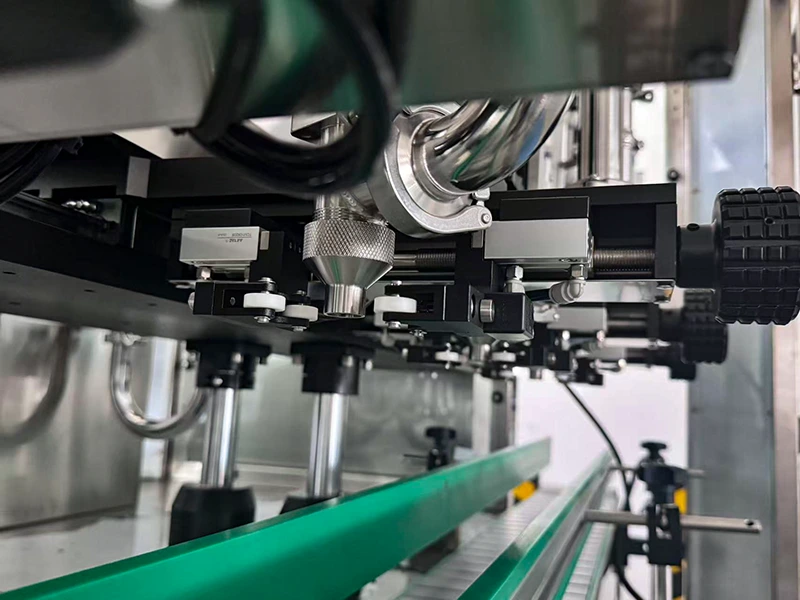
For sauces from free-flowing to thick, what matters is not maximum speed but a volumetric piston dose, container follow-through without stopping and dismountable sanitary piping; the remaining parameters are checked against your product range at the selection stage.
Questions covered
- 01
- How to choose sauce filling equipment if the product at the line ranges from free-flowing to thick?
- 02
- Why does the dose drift and the product splash over the container neck during positional filling?
- 03
- What to check in the sanitary design and cleaning of a sauce filling machine?
Who selects equipment for sauce packaging, and why the task does not come down to a single number
Sauce production is almost never single-assortment: one site runs ketchup and tomato sauce, mayonnaise, dips, honey, gel, and tomato products. Consistency ranges from free-flowing to thick and viscous, and the same machine must handle that entire range.
Containers are mixed as well: glass and PET containers, jars, bottles of different neck diameters and different heights. The requirement for the machine is to be changeable over to a format, not to accumulate a separate machine for every type of bottle.
Hence the practical conclusion for selection: first compare the dosing method, the fit to the container, and the sanitary design, and only then look at speed. Otherwise the machine is bought for one product and a month later sits idle on another.
What holds back semi-automatic and positional filling
Positional, that is stop-and-go filling: the bottle stops under the nozzle, the dose is poured, then the container starts again. On start-up the product is agitated and splashes, the level at the neck is unstable, the whisk gets soiled, and this leads to both overfill and drips in the label area.
Semi-automatic manual filling with a ladle puts the dose in the operator's hands: variation from portion to portion, losses on filling, downtime when the person changes. For viscous products it also means uneven filling of the container.
A purely pneumatic dosing drive depends on line pressure: the piston stroke changes with air fluctuations, and the dose drifts with it. With an unstable air supply, the result is either overfilling or underfilling.
Another issue is narrow specialization. A machine selected for one viscosity and one format handles the adjacent product from the same formulation line poorly, so instead of one machine in the area there are two.
Piston dosing with a three-way valve and container tracking
Dosing is based on piston pumps: the pump sleeve itself is the metering chamber. First a dose is drawn into it, then it is pushed out — the quantity is set by volume, not by product discharge time, so viscosity does not affect the dose in this way.
Flow switching is handled by a three-way rotary valve: one position draws from the hopper into the metering cylinder, the other delivers from the cylinder to the filling valve. One valve per cycle; the paths do not mix.
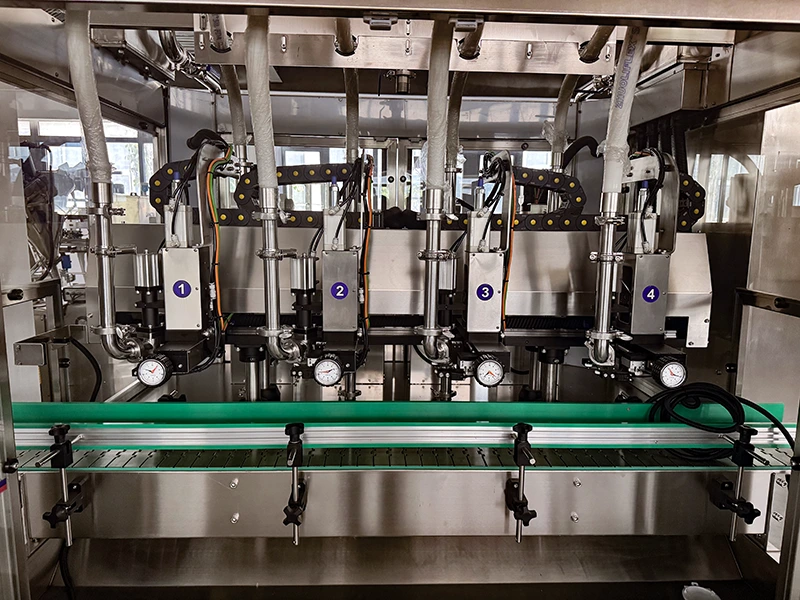
Four filling heads operate on the move: while the conveyor carries the containers, the heads move horizontally with them and fill the bottles without stopping. This is the answer to splashing — the product does not get a jolt from the stop-start of the containers.
Container fit is handled mechanically: interchangeable filling nozzles, adjustable grippers with variable spacing between them, an adjustable backstop for height and pitch, and head lifting by pneumatic cylinder to match container height. For each format, the tooling is changed, not the machine.
What to look at in the design: drive, feed and washing
Feed and level. The U-shaped hopper is equipped with a level sensor that controls the feed pump: when the controlled level is reached, the feed stops. This eliminates overflow and running the pump without product.
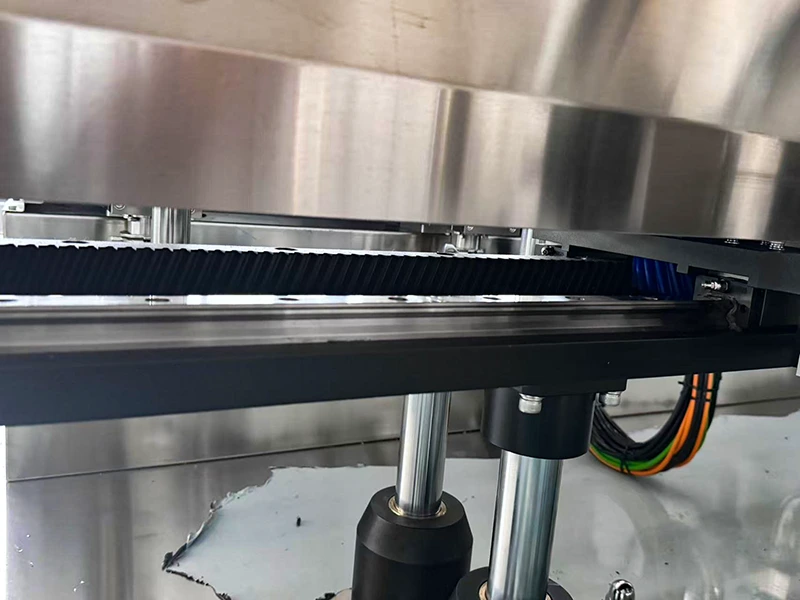
Tracking drive. The heads travel along a helical rack with a servo gear drive and a linear guide; each of the four heads has its own servo drive, and the piston pumps are driven by servo motors that set the speed and the number of revolutions. Control is on the PLC, with setting and monitoring via the operator panel.
Sanitation. The frame and piping are made of 304 stainless steel, the pipelines are on quick-release clamps, and there is a flushing valve with a drain into the drip tray and a side outlet. The circuit is flushed with water without fully disassembling the units, which matters for viscous products.
Observation and protection. Transparent tempered glass doors at the front, at the rear and on the electrical cabinet enclose the moving parts while allowing a view of the filling zone without opening. Dose and speed are set on the panel, and the status and the number of filled bottles are displayed.
What result this scheme delivers per shift
Continuous feed: containers move along the slat conveyor without stopping, four heads operate simultaneously, and the cycle is no longer split into "stop — fill — start".
Stable dose: volumetric piston dosing under servo drive plus splash-free filling result in fewer defects at the neck and rim and fewer reworks. Accuracy and tolerance are not stated in advance — they are confirmed at the selection stage.
Cleaning and changeover: quick-release connections and a flushing valve reduce the time for disassembling the circuit, while interchangeable nozzles and adjustable grippers cover several glass and PET container formats.
Interface with downstream operations: the stainless steel conveyor and frame provide a basis for integrating the machine into the section before capping and labeling. Capping and labeling themselves are adjacent line operations, not functions of this machine.
Application boundary
Dose range, capacity, dosing accuracy, permissible viscosity window, voltage and power, air pressure, dimensions and weight are not confirmed in the open materials — clarified on request, at the selection stage. Compatibility with a specific product and container format is checked on a sample. The possibility of interfacing with capping and labeling is determined by the layout of the section.
Select equipment for your sauce and container
Send us the product, its consistency and the container format — we will select the layout, tooling and confirm the parameters on a sample.