
CODAPAK
Piston dosing equipment for thick sauces: four heads without stopping the bottle
Piston dosing of thick and viscous products into glass and PET containers: four servo-driven piston dosers, dynamic movement of the heads together with the bottle on a chain conveyor, and continuous filling instead of positional stops.
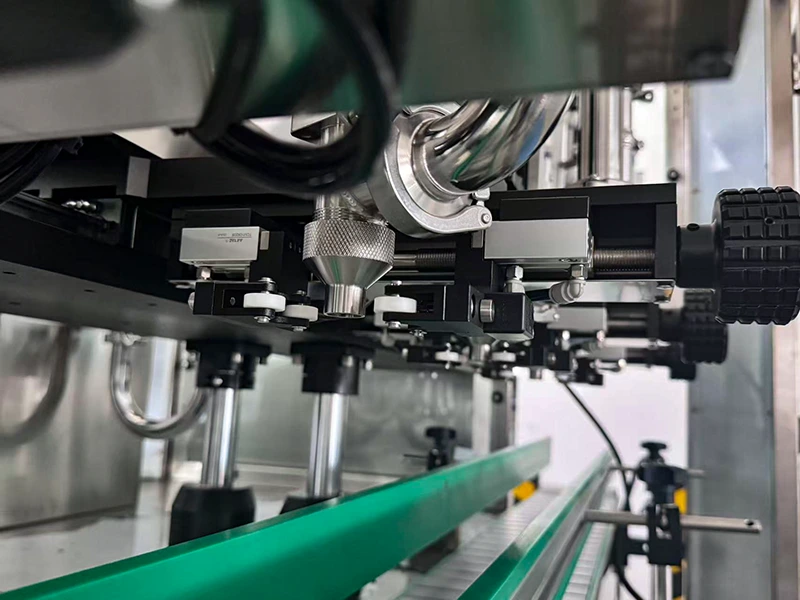
If the product is thick — sauce, ketchup, tomato paste, honey, or gel — the bottleneck in the line is often not the pump, but bottle stops for positional filling. Piston dosing with four heads and a servo drive allows dosing on the move: containers keep moving, and the heads move together with them.
Questions covered
- 01
- Why does thick product become agitated and produce an uneven level during positional filling?
- 02
- Why does a piston filler need a servo drive instead of compressed air pressure?
- 03
- How should pipelines for thick products be disassembled and flushed?
- 04
- How many heads should you choose — 2, 4, or 6?
Filling thick sauces: where the line rhythm breaks down
Ketchup, tomato sauce, tomato paste, honey, and gel are thick, viscous products that handle frequent starts and stops poorly: the inertia of the mass continues to act even after the container has stopped.
Conventional position-based filling requires stopping the bottle and then accelerating it again. On start-up, the product in the bottle is agitated and splashes, so the fill level ends up uneven.
The result is level rejects, drips on the neck, and unnecessary changeovers instead of consistent filling into glass and PET containers.
Dosing on the move: why the bottle does not need to stop
In this machine, the chain conveyor continuously moves the bottles, and the dosing heads move synchronously together with the containers — in the direction of their movement and at their speed.
The level in the bottle remains calm: there is no splashing or agitation, because the containers do not stop and are not accelerated again. This is the main argument against positional filling.
The movement of the heads following the containers sets the rhythm of the entire line: it runs continuously rather than in stop—fill—start bursts.
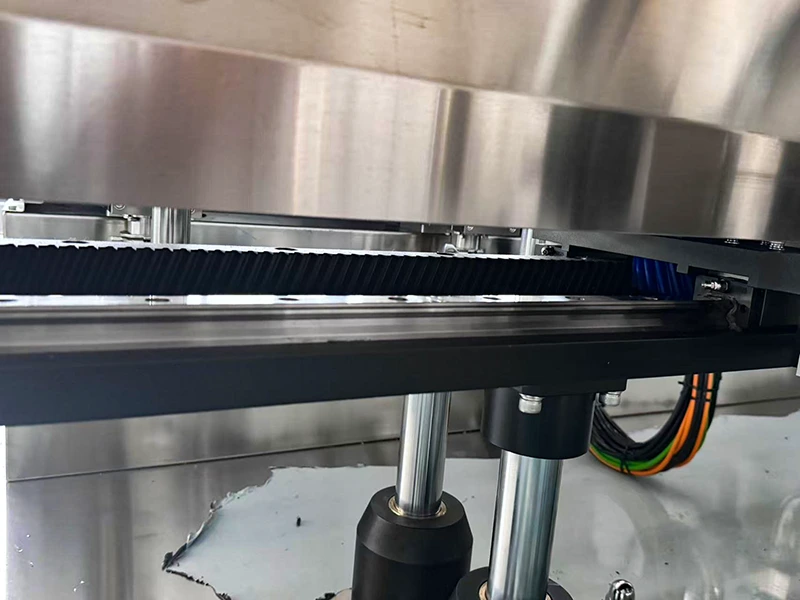
Horizontal travel is provided by a gear rack with a pinion on a servo motor and linear guides; the heads can operate in pairs or individually.
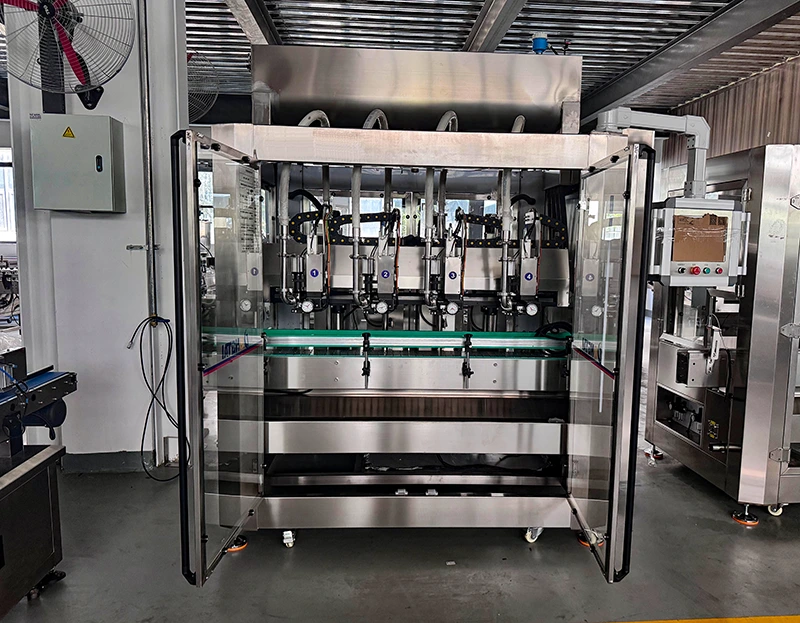
Four piston dispensers: intake — dosing — discharge cycle
Dosing is performed by four piston pumps. The dispenser cylinder also serves as a measuring chamber: first it draws in a portion of product, then pushes it out into the container.
Intake and discharge are switched by a three-way valve: from the U-shaped hopper the product goes into the measuring chamber, and from it — to the filling nozzle.
Two stainless steel pipes connect the hopper to the piston dispensers. The filling nozzle is replaceable, so the format is selected by replacing the part, not by reworking the assembly.
The dose range per documentation is 50–1000 ml, with the option to adapt it to the task. This is a design parameter, not a guarantee for any container.
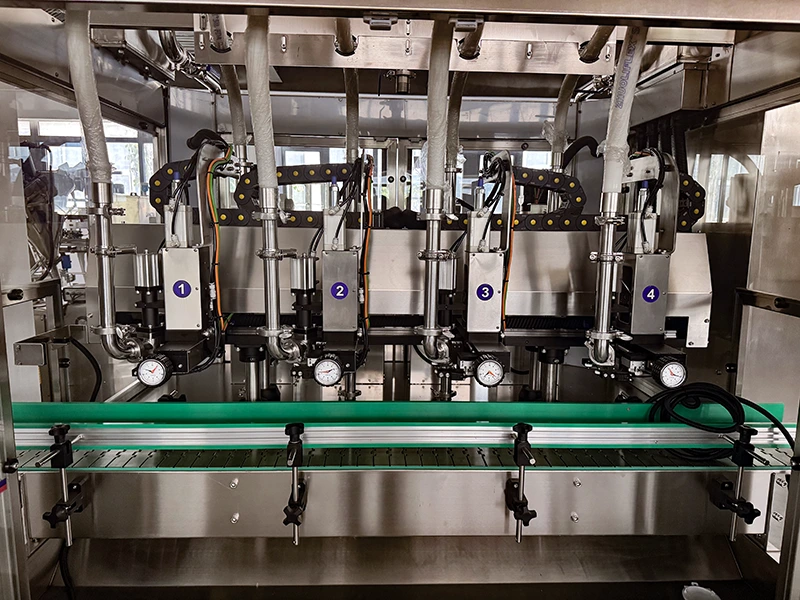
Servo drive instead of compressed air
The stroke of the pneumatic piston depends on line pressure: a pressure surge in the plant changes the stroke, and therefore the dose in the bottle.
Here, four piston dosing units are driven by servo motors: the dose is set by the number of revolutions and rotation, not by air pressure, so it does not drift with the condition of the compressed air network.
Compressed air is responsible only for valve opening, head lifting and bottle clamping — via an air preparation unit with filtration.
The machine has ten servo drives in total: four for the piston pumps, four for horizontal movement of the heads, one for the height of the entire assembly and one for the chain conveyor. Control is via PLC; the cabinet also contains a frequency converter and power switching.
Washing, draining and process monitoring
Viscous product pipelines are assembled with quick-release clamps: the circuit can be disassembled on site, without cutting out welded sections.
For flushing, water or prepared water is passed through the system; the drain valve diverts product from the hopper into a separate container and discharges it at the side of the machine.
The upper unit is a U-shaped hopper with a level sensor: when the threshold is reached, the feed pump stops, and product does not overflow over the edge.
The 304 stainless steel frame and tempered glass protective doors allow you to see the heads operating without opening the machine. The dose, speed, and number of filled bottles are set and displayed on the touch screen.
What this provides for production and how to choose the number of heads
The bottom line is simple: continuous container feeding plus servo dosing provide a consistent level in the bottle and fewer stops on the filling line for viscous products.
The series includes 2, 4, and 6 heads. This piston dosing equipment is a four-head version: 4 heads, 40–50 bottles per minute according to the series table.
2- and 6-head versions are adjacent variants in the series: their values (20–40 and 70–120 bottles per minute, power 2.1 / 4.5 / 6 kW, dimensions and weight 600 / 700 / 800 kg) are given as series reference, not as the measured output of the four-head machine.
For sauces, ketchup and tomato products, the version is selected by product and container: glass or PET bottle, dose volume and required line rate. Suitability is confirmed for the specific product and container.
Application boundary
The material describes the piston dosing machine and its components. We do not provide air pressure (the number is distorted in the source data), dosing accuracy, maximum viscosity, changeover time, washing and CIP parameters, certificates, warranty, or measured output — there is no confirmed data on them. Capping and labeling are adjacent line operations, not parameters of this machine. The values for 2 and 6 heads relate to the series as a whole. Selection for a specific product and container is performed separately.
Select a piston dosing machine for your product
Describe the product, container and required line rate — we will select a version by number of heads and dose volume.