
CODAPAK
Filling and packaging system for sweet sauce: even level without stopping containers
Sweet sauce is a thick and viscous mass, and positional filling with the bottle stopped causes a surge, uneven level and drips on the neck. We explain how the FTPfill filling and packaging system is designed: four servo-driven piston fillers, dynamic (tracking) filling while the conveyor moves and a three-way valve for precise filling of glass and PET containers.
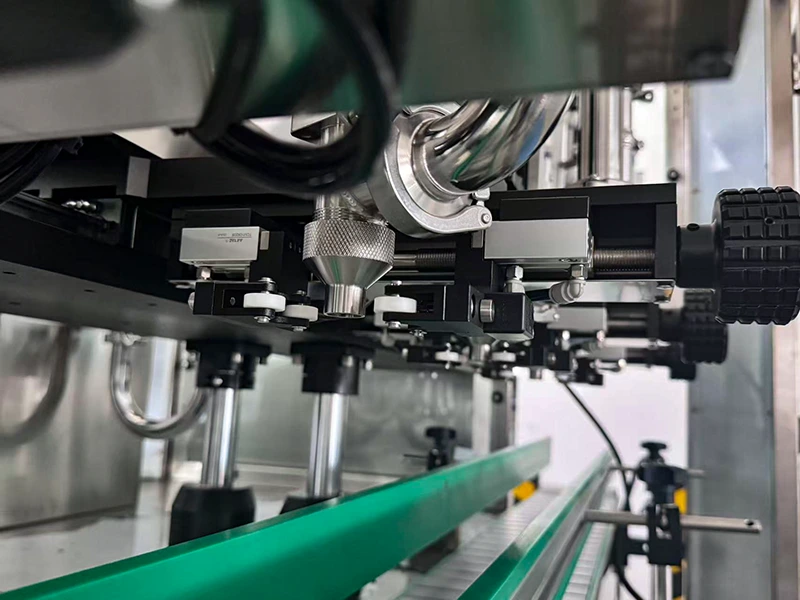
For sweet sauce, what matters is not the conveyor speed but the dosing scheme: if the bottle stops under the nozzle, the thick mass sloshes and the level goes off. The FTPfill system fills on the move — four servo-driven piston fillers track containers, and a three-way valve divides the cycle into suction and dosing.
Questions covered
- 01
- Why does sweet sauce splash during positional (stop-and-go) filling, and what does this produce at output?
- 02
- How does dynamic (tracking) filling work, and why should containers not stop?
- 03
- Why are piston fillers servo-driven rather than compressed-air-driven?
- 04
- What does the operator see and control: HMI panel, control cabinet, hopper level?
- 05
- What are the series benchmarks, and what data must be confirmed for a specific sauce and container?
Sweet sauce on the conveyor: where exactly does filling quality get lost
Sweet sauce is a thick, viscous mass. When filling into glass or PET containers, three things matter: a level fill in the bottle, a clean neck, and consistent fill from bottle to bottle.
A filling and packaging system for sauces is built around the dosing unit. It determines how the product behaves at the moment of filling; the conveyor and downstream operations only set the pace of the filling line for thick products.
What is wrong with positional filling
In positional (stop-and-go) filling, the bottle stops under the nozzle and then starts again. The inertia of the thick mass causes sloshing and splashing: the level deviates from the target, and the sauce can get onto the neck and body of the container.
Volumetric dispensers with pneumatic drive add a second variable: the piston stroke depends on the pressure in the compressed air line, and the fill deviates from the set value. According to the source, it is precisely because of unstable pressure that the stroke changes, and along with it the dose changes.
For sweet sauces with sugar and thickeners, this is more expensive than usual: viscosity is higher, drips on containers are more frequent, and the share of rejects and rework grows. Accurate filling without splashing directly reduces these losses.
Dynamic (tracking) filling: containers do not stop
FTPfill — a four-head dispenser with tracking. The bottle moves continuously along the slat conveyor, and the filling heads move synchronously with it and fill directly on the move.
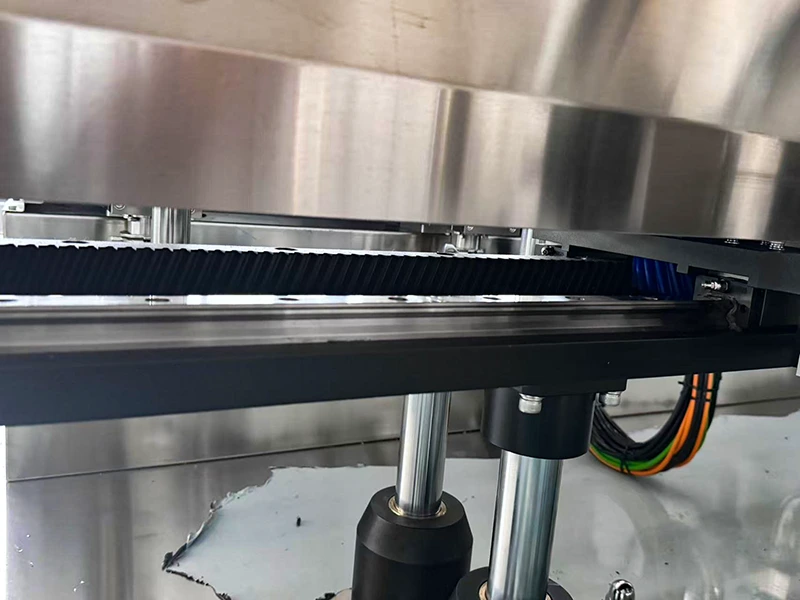
The heads are mounted on a carriage with an inclined gear rack and linear guides: a servo motor moves them horizontally via a gear in sync with the container movement. The four heads can operate in pairs or individually. While filling is in progress, a clamp holds the neck, and the head lowers and aligns the nozzle with the axis of the bottle.
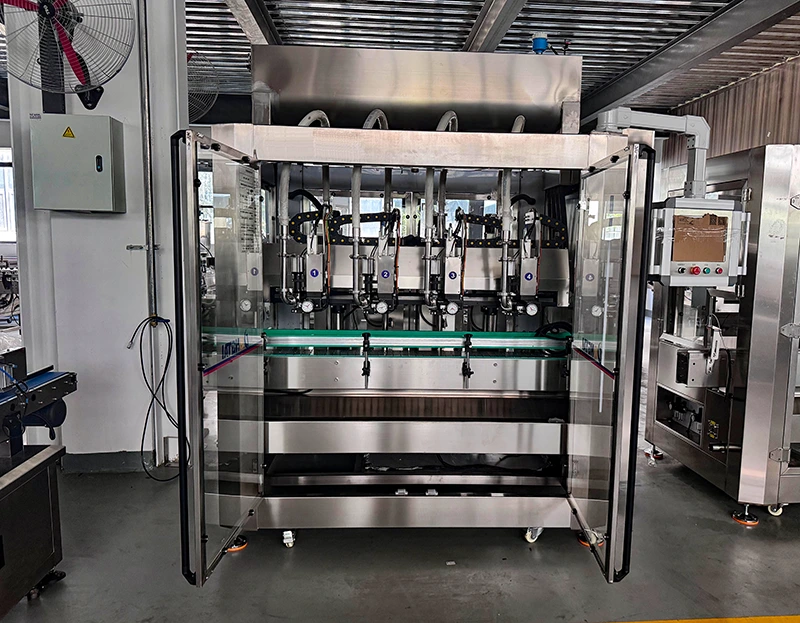
The suction–metering–dispensing cycle in four piston dispensers
Four piston pumps operate in a suction — dosing — discharge cycle: first the piston draws in the product, then dispenses the measured volume into the bottle. The piston pump body also serves as the measuring chamber.
Flow switching is performed by a three-way rotary valve: in one position it connects the hopper to the metering tank, in the other it connects the metering tank to the filling nozzle. The nozzles are removable, so they can be changed for different neck sizes.
The product is fed into the hopper by a pump controlled by a level sensor: when the control mark is reached, feeding stops. This prevents overflow and dry running.
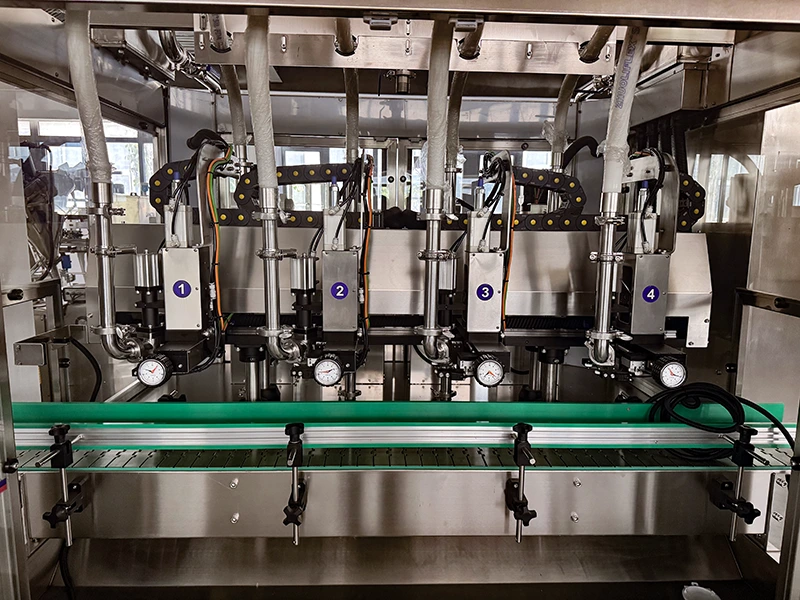
What the operator sees and controls
Fill volume and speed are set on the HMI touch panel; the machine status and the number of bottles already filled are also displayed there. Next to them on the panel are the start, stop, and emergency stop buttons.
Motion is controlled by ten servo motors: four drive the piston pumps, four move the filling heads, one is responsible for the height of the entire unit, and one for the slat conveyor. The main controller is a PLC; a frequency converter, power supply, relays, circuit breakers, and terminal blocks are also installed.
The electrical equipment and components are enclosed by transparent doors made of tempered glass: the status is visible without disassembly, while moving parts are separated from personnel.
Maintenance and changeover: what to look at
The pipelines are assembled with quick-release clamps, and the drain valve discharges contaminants from the hopper into a separate tank with a side outlet. The circuit is washed with clean or sterile water.
When changing containers, the neck clamp (grip pitch), the position and height of the stops, and the height of the filling head block are adjusted and, if necessary, the nozzles are changed. The exact changeover time is not stated in the source.
The system stands on swivel casters for movement and is secured with support feet; the hopper has a U-shaped design, and two stainless steel pipes run to the piston pumps.
Application boundary
The material covers positioning, structure, control, and the specification table for the series. According to the source, the following cannot be cited without separate confirmation: compressed air pressure (the figures in the original are distorted), dosing accuracy and deviation, maximum product viscosity, changeover time, cleaning and CIP parameters, certificates, warranty, and actual measured throughput. The values for 2 and 6 heads are only a comparison within the series, not measured data for the four-head machine. Suitability for a specific sauce and container is confirmed separately for each case. The four-spindle capping machine is an adjacent operation after filling, not a parameter of FTPfill.
Discuss filling for your sauce
Describe the product, viscosity, and container — we will select the dosing unit configuration and check compatibility with your filling line.