
CODAPAK
Packaging machines for mayonnaise: filling without stopping the jar
Mayonnaise is a thick emulsion, and with positional filling the jar stops under the nozzle and starts again: the product is agitated, the dose drifts, and sauce ends up on the container rim. The four-head FTPfill machine carries containers along a chain conveyor without stopping and doses with four servo-driven piston pairs: 50–1000 ml per dose, 40–50 jars per minute according to the series data sheet.
For mayonnaise, the machine is chosen by three criteria: the container does not stop under the nozzle, the dose is set by a servo-driven piston rather than air pressure, and all product-contact parts come apart with quick releases for cleaning. The data sheet values of 50–1000 ml and 40–50 jars per minute apply to the four-head version; viscosity and dosing accuracy are confirmed on your sample before ordering.
Questions covered
- 01
- Why is mayonnaise filled into glass jars without stopping the container?
- 02
- How does a servo-driven piston doser differ from a pneumatic one, and what does that give the dose?
- 03
- What needs to be reconfigured when switching to a different jar or bottle format?
- 04
- How is a thick sauce doser washed between batches, and what does the operator see during a shift?
- 05
- What rated specifications does the four-head version have, and what data is not stated?
Mayonnaise is not water: where exactly dose quality is lost
Mayonnaise, ketchup, tomato paste and other thick sauces behave differently in the line than water: high viscosity and a dense emulsion. When the jar stops under the nozzle and then starts moving again, the sauce in it is shaken up, the level at the neck fluctuates, and some of the product ends up on the rim of the container.
This is exactly how positional, stop-and-fill filling and semi-automatic ladle filling work: containers are placed by hand, the dose is topped up by eye, and the output is jars of varying weight within one batch and spillage over the neck.
For the shop floor this means three losses at once: excess sauce consumption due to spillage, manual wiping of every jar, and re-filling of part of the batch. That is why an automatic sauce doser is chosen not by the number of heads, but by whether the container stops under the nozzle or not.
How container-tracking filling works
In the FTPfill machine the jar does not stop: a chain conveyor carries it along the line, and four filling nozzles move together with the container in the same direction and at the same speed. This is dynamic, tracking filling of thick products, not filling in place.
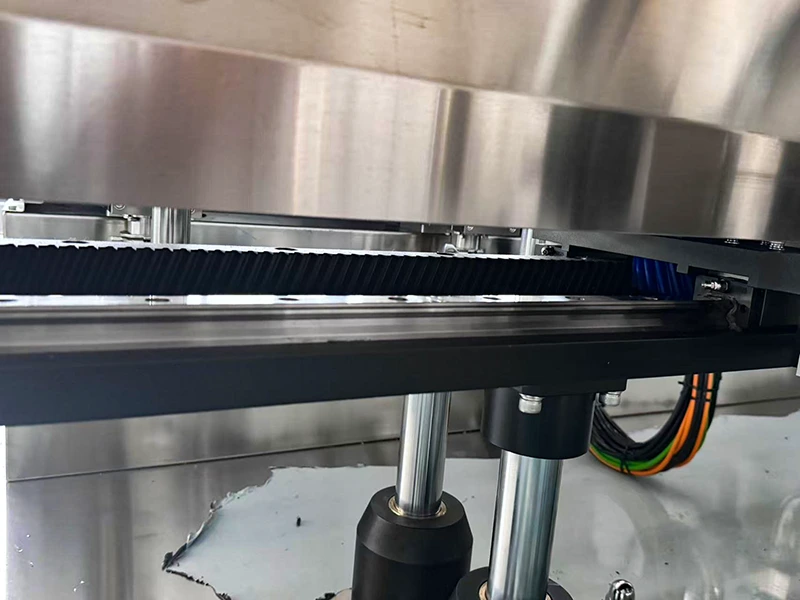
The horizontal movement of the heads is based on a helical rack, a gear on a servo motor and a linear guide. Before filling, a pneumatic cylinder lowers the head block, and clamps hold the jar by the neck with diameter adjustment, so the nozzle and the neck stay on the same axis even while moving.
The practical result is an even product surface without splashing: the sauce does not strike the wall during starting and braking, and the level in the jar remains predictable. According to the machine description, this is the main argument against stop-and-fill filling into glass and PET containers.
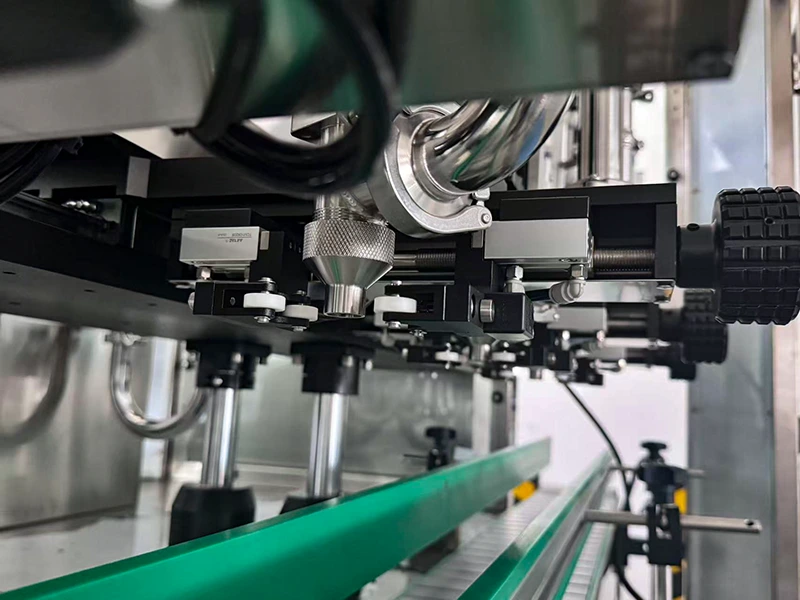
Four pistons: where dose repeatability comes from
The dose is set by four piston dispensers. The body of each piston also serves as a measuring chamber: first the piston draws the sauce from a U-shaped hopper through two stainless steel product lines, then a three-way rotary valve switches the flow to the filling nozzle, and the piston presses the dose into the jar.
This piston dosing delivers a volumetric dose that does not depend on how long the product flows by gravity. The four heads can operate in pairs or individually, so wide formats are run in four lanes and narrow ones in two without replacing the machine.
The hopper has a level sensor: when the threshold is reached, the feed pump stops. This protects against overfilling the tank and against running “on air,” when foam instead of product enters the dose. The frame shows four vertical cylinders with blue sight windows; the operator uses them to monitor filling of the metering chambers.
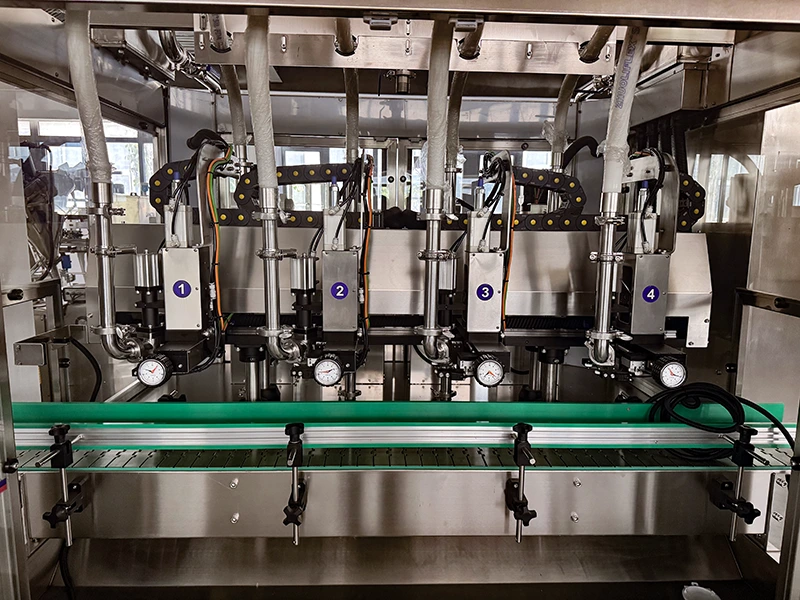
Servo drive instead of air: what is visible in the control cabinet
There are ten servo drives in the control cabinet: four drive the piston pairs, four the horizontal movement of the heads, one the height of the entire unit, and one the chain conveyor. The main controller is a PLC, next to it are a frequency converter, power supply, relays, circuit breakers, and labeled terminal blocks.
Why this matters more than it seems when choosing a dispenser for viscous products: with a purely pneumatic piston, the stroke length depends on line pressure, and a pressure drop throws off the dose. Here the volume is set by the number of revolutions and the speed of the servo motor, so air fluctuations in the pneumatic line affect the valves and clamps, but not the metering stroke.
Pneumatics remain for auxiliary operations — opening valves, lifting heads, clamping containers — and the air passes through a preparation unit with a filter. The pneumatic tubes are routed in a drag chain, and the cabinet with transparent doors and two cooling fans can be inspected without disassembly.
Changeover to another format: what is actually adjusted
When changing over to another jar or bottle, four assemblies are adjusted: the distance between the neck clamps, the height and pitch of the guide rails on the conveyor, the height of the head block and, if necessary, the filling nozzles are changed to suit the neck diameter.
The manufacturer claims adaptive positioning by neck and format changeover without complex setup, but the changeover time is not given in the documentation. This point is covered by a trial filling run on your own containers, not by a calculation from the catalog.
A dose range of 50–1000 ml per head means that one machine covers both a small glass jar and a large-volume bottle: a 200-gram jar and a 500-milliliter PET bottle run on the same machine with different dosing settings.
Rinsing, monitoring and nameplate data of the four-head version
Hygiene for a thick sauce is not only about washing but also about access. Product lines are assembled with quick-release clamps, a three-way valve and a rinsing circuit allow clean or sterile water to be run through the dosing units, and the flush from the hopper goes into a separate vessel and is drained from the side of the machine.
Operation can be observed without opening the machine: the front and rear doors are made of clear tempered glass, the electrical cabinet doors are transparent, and the touchscreen is used to set the dose volume and speed and displays the current status and the number of filled jars.
Nameplate data for the four-head version: dose 50–1000 ml, 40–50 jars per minute, power supply 380 V / 50 Hz, power 4.5 kW, dimensions 2200×1400×2200 mm, weight 700 kg. The 2- and 6-head variants are given in the same series table and are for comparison only, not as specifications of this machine.
Data boundaries: the air pressure value in the source document is distorted and is not published; maximum viscosity, dosing accuracy, changeover time, CIP cleaning parameters, certificates, and warranty are not given in the data sheet. Packaging equipment cost is calculated according to configuration — number of heads, container format, and line composition.
Application boundary
The article describes the FTPfill four-head filling machine. The machine does not perform raw material preparation — receiving, washing, crushing, straining, concentration, pasteurization — does not fill into bags and sachets, and does not cap or label containers: capping and labeling remain adjacent line operations. The values for 2 and 6 heads are taken from the general series table. Dosing accuracy, maximum viscosity, changeover time, and confirmed capacity on a specific product are not stated and are verified on a sample.
Test mayonnaise on your sample
Send us the dose volume, jar or bottle format, and product description — we will select the number of heads, assemble the dispenser configuration, and agree on a trial filling run with your sauce.