
Ketchup filling into tinplate cans: four-head dosing unit with precise positioning under the lid
A tinplate can has a narrow neck and is seamed right after filling, so a deviation of a couple of millimetres means scrap. The four heads locate the can while it moves on the conveyor and pour ketchup exactly where the future lid will sit, without spilling over the rim. The can then goes to lidding and seaming — we confirm the line interface on your samples.
01
What changes with this machine
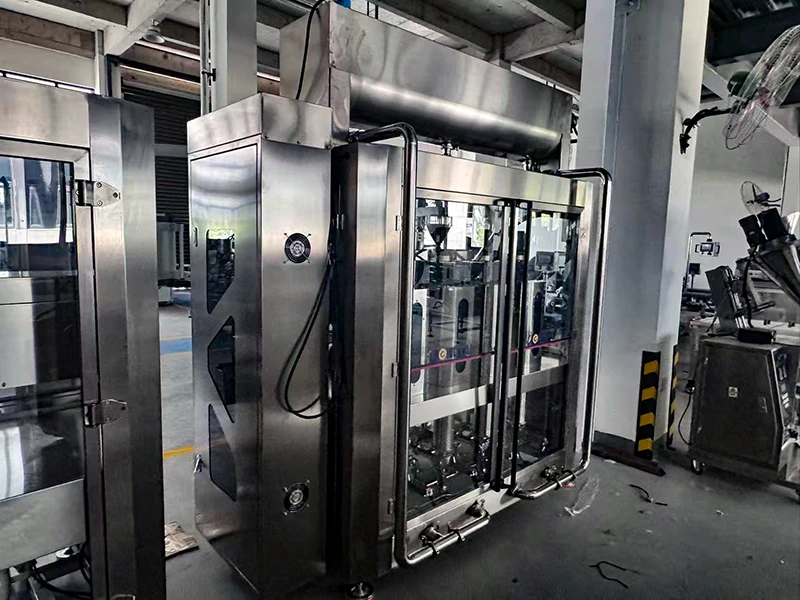
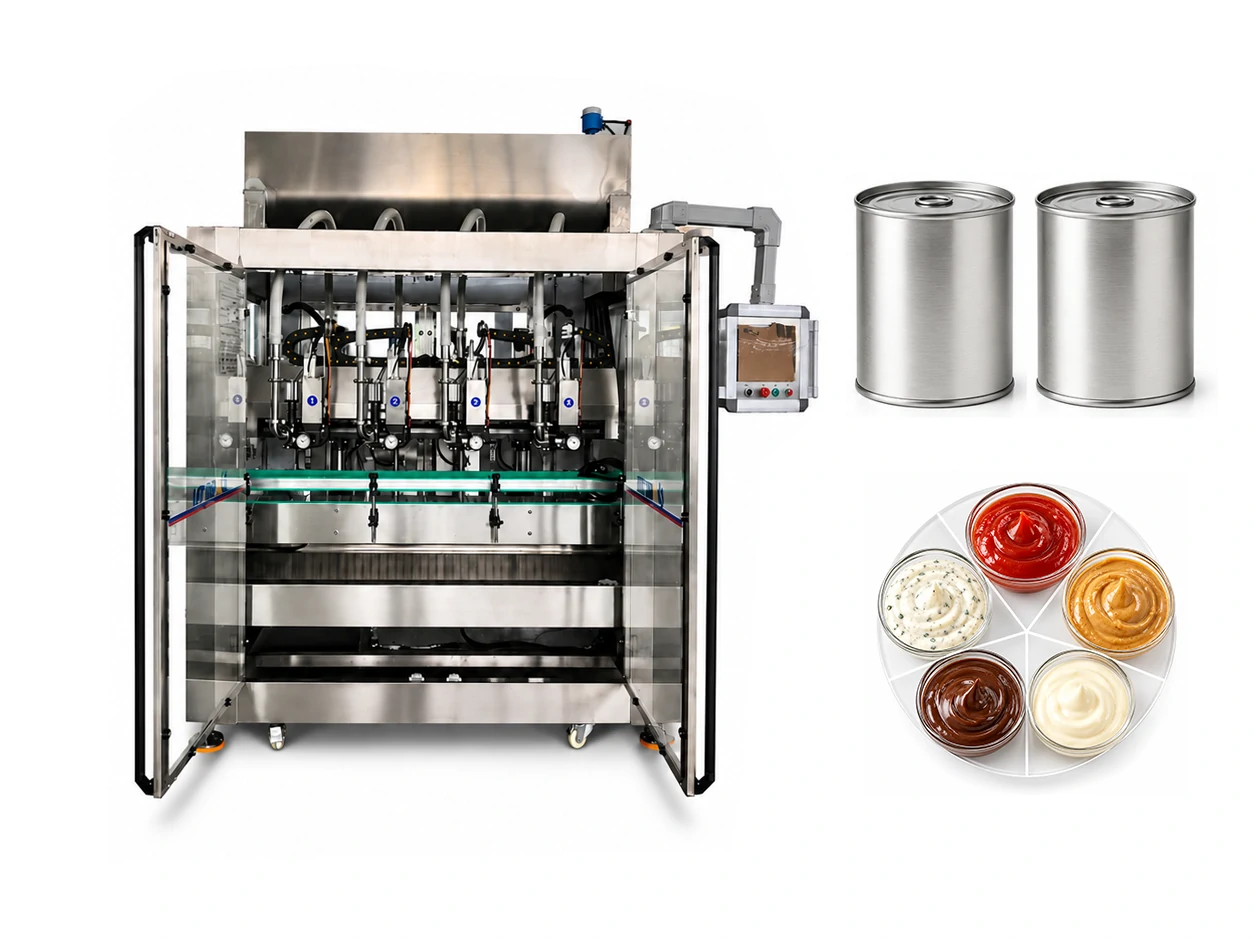
The tinplate can never stops under the filling heads: it moves continuously on the slat conveyor while the four fillers follow its speed. The stop–start cycle disappears, so useful output rises. The product in an open can stays calm: in-motion filling has no inertial surge that causes uneven levels and marks on the walls. For tinplate specifically, the dose is matched to the headspace under the lid so the can is properly closed and seamed. Tinplate does not shrink like glass, so geometry is more stable, but grippers and conveyor guides are still set per diameter and height. Frame and working parts are 304 food-grade stainless steel with clear tempered doors.
The product is a viscous or thick mass: ketchup, tomato sauce, tomato paste, adjika, mayonnaise, cream sauce, cheese sauce, mustard sauce, soy sauce, pesto, béchamel, BBQ, curry.
Containers are tinplate cans: body diameter and height, headspace under the lid, and the seam area for seaming.
Container feed is continuous on a slat conveyor; this machine is not designed for stop-and-position filling.
The site provides 380 V / 50 Hz power and 0.6–0.8 MPa compressed air through a filter-regulator.
Product changeover allows washing with water or sterile water, collecting waste liquid in a tank and draining it through a side outlet.
Required output for 4 heads is 40–50 cans per minute; 2-head and 6-head versions cover other tasks.
Position in the line: after product preparation and feeding, before lidding and seaming. Product goes from the hopper through stainless pipes into the dosing cylinders, through three-way rotary valves and filling heads into the can; the slat conveyor carries the filled can to lidding, then to seaming, labelling and packing. A different feeding arrangement is a separate configuration.
02
Specifications by head count
Values come from the product manual; the output unit follows the pack format.
| Number of filling heads | 4 heads (2 and 6 available) |
|---|---|
| Dose range | 50–1000 ml, configurable |
| Output | 40–50 cans/min |
| Voltage | 380 V / 50 Hz |
| Power | 4.5 kW |
| Compressed air | 0.6–0.8 MPa |
| Overall dimensions | 2200×1400×2200 mm |
| Weight | 700 kg |
03
Construction and process
Positional filling: what the stop costs
In a stop-and-dose scheme the can brakes under the filler, completes the dose and starts again. At start-up inertia moves the product: the surface does not settle, marks stay on the walls, and part of the product goes to rework.
For a tinplate can this is also a sealing-phase question: a contaminated rim and a surge at the bottom complicate lidding and the seam.
Solution: in-motion filling without stopping the can
The tinplate can moves continuously on the slat conveyor. Four filling heads track its speed and follow on a rack-and-pinion and linear guide, grippers hold the can on the nozzle axis, and dosing happens on the move.
The product surface stays calm and the line loses no time to stops. Pneumatic lines on the moving heads are protected by a nylon chain; pipes come apart with quick-release fittings.
Feeding and dosing: hopper with level sensor and piston fillers
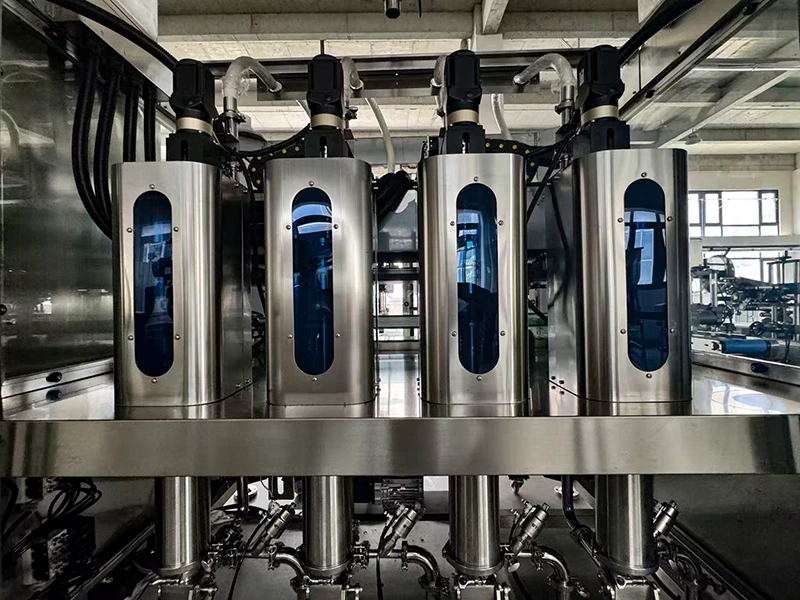
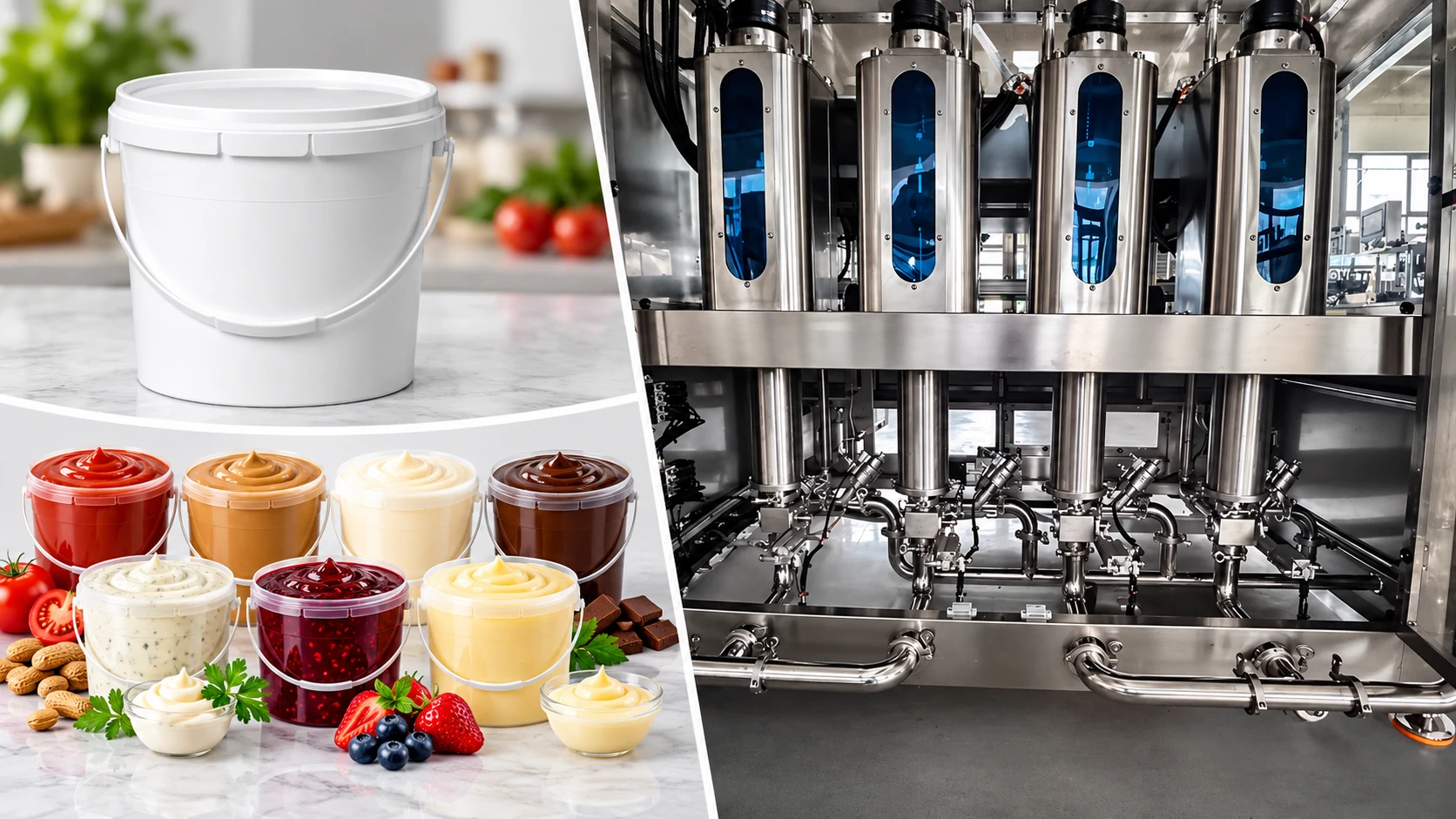
The U-shaped hopper with a level sensor stops the feed pump at the set level. Product travels through stainless pipes into the dosing cylinders; the plunger draws and pushes the dose while three-way rotary valves switch the flow between hopper, cylinder and filling valve.
Dose is set by servo revolutions, so volume does not depend on air quality. A cylinder brings the nozzle to the can neck or partly inside to reduce splashing. After the cycle the machine washes with water or sterile water and collects waste in a tank.
Filling station: four heads and setting up for the can
Head movement comes from a servo-driven rack and a linear guide. Two heads can work as a pair or individually. A cylinder brings the nozzle to the can neck or partly inside to reduce splashing.
A tinplate can does not shrink like glass, so its geometry is more stable; still, the neck grippers are adjusted by screw to the diameter and height of the specific can, and the conveyor guides are set so the can travels straight under the grippers.
Products and containers this line is built for
The line is built for viscous products in tinplate cans: sour cream, yogurt, kefir and fermented dairy; ketchup, tomato sauce, sweet sauce, hot sauce, sweet-and-sour sauce, adjika, tkemali, pepper sauce, chili sauce; cream sauce, white sauce, cheese sauce, béchamel, mayonnaise sauce, garlic sauce, mustard sauce, mint sauce; soy sauce, teriyaki, pomegranate sauce (narsharab), satsivi, oyster sauce, curry sauce; pesto, basil sauce, bolognese, caesar, tartare, onion sauce, cucumber sauce, thousand island, shriracha, demi-glace; BBQ sauce, meat sauce, beef sauce, chicken sauce, mushroom sauce, fish sauce, nut sauce, truffle sauce, cream sauce; winter plum sauce, apple sauce, apricot sauce, cranberry sauce, lingonberry sauce, honey sauce.
If your product is not on the list, tell us: the engineer will advise on dosing mode and a replaceable nozzle for the actual viscosity.
04
Machine photos
05
What to confirm before ordering
Send samples — we test on your product and build the configuration around it.
- Container: tinplate can diameter and height, headspace under the lid, geometry tolerances.
- Closure and seam: lid type, requirements for the can rim and the seamed seam.
- Samples of the empty can and the lid — the key material for checking the seaming interface.
- Product: viscosity, filling temperature, presence of solid particles.
- Whether the finished product is heat-treated or sterilised.
- Equipment before and after: can feeding, lidding, seaming, labelling; conveyor height.
- On-site power and air supply, access for maintenance and cleaning.
Confirmed by testing, not promised
Compatibility of the filler outlet with your can format, the required headspace under the lid, and the interface to lidding and seaming are not claimed as confirmed values: they are checked on your can and lid samples before shipment. Actual dose, real output, product residue in the cylinder and at the nozzle, and wash duration and quality are confirmed by testing on the customer's product. Equipment for another feeding arrangement, head count or container type is a separate configuration.
Ketchup filling into tinplate cans: four-head dosing unit with precise positioning under the lid
We will size the configuration for your can and product
Send the container and product parameters plus samples of the empty can and lid — we will prepare the line scheme, the output calculation and the price.
✓ 15+ years of experience · ✓ own factory in China · ✓ free sample testing