
Tube filling and sealing machine: 2–300 ml tubes filled and sealed
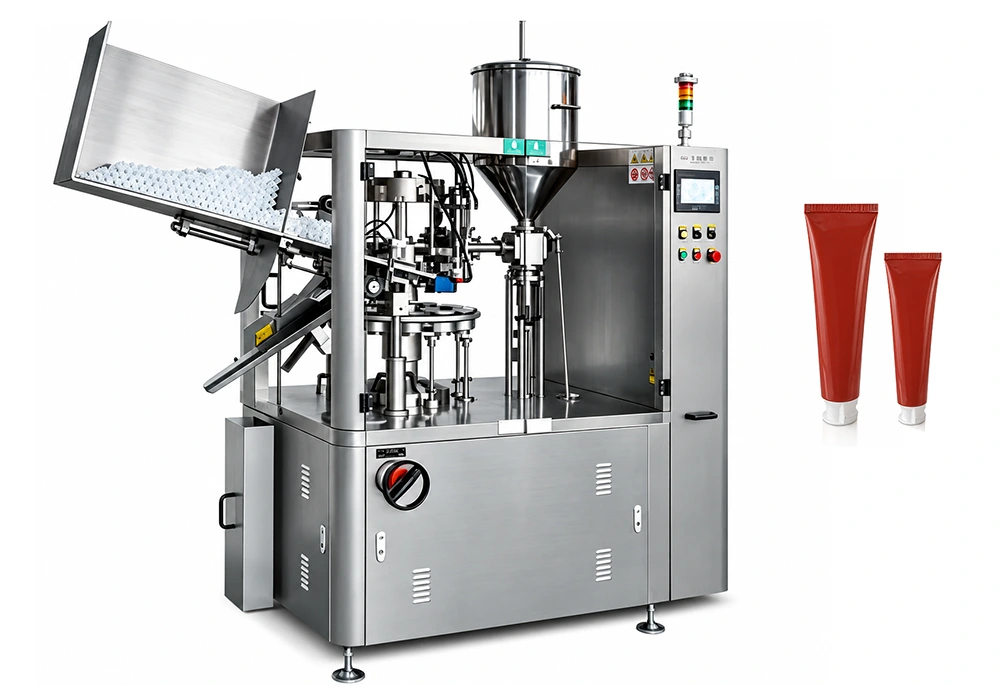
Rotary automatic machine for filling and sealing flexible tubes: plastic, laminated and aluminium. Dosing 2–300 ml at ≤ ±1% accuracy, output 60–80 tubes/min, tube diameter Φ10–60 mm. Nine operations on one indexing table — from feeding an empty tube to discharging the finished product.
01 · Что даёт станок
Nine operations on one indexing table
A flexible tube completes the full cycle without manual handling: the empty tube is fed into an inclined hopper, stood upright in a nest, registered against the colour mark, optionally filled with inert gas, dosed through a submerged nozzle, crimped after the tail is heated, trimmed and discharged onto the conveyor. According to the manufacturer's documentation the share of conforming product is at least 99.5%, excluding causes related to the tube material.
Submerged nozzle and inert gas
Product enters from the bottom, so the gas stays above the product in the tube. Optionally the tube is filled with nitrogen: oxygen is displaced, oxidation and aerobic microbial growth slow down, and shelf life extends.
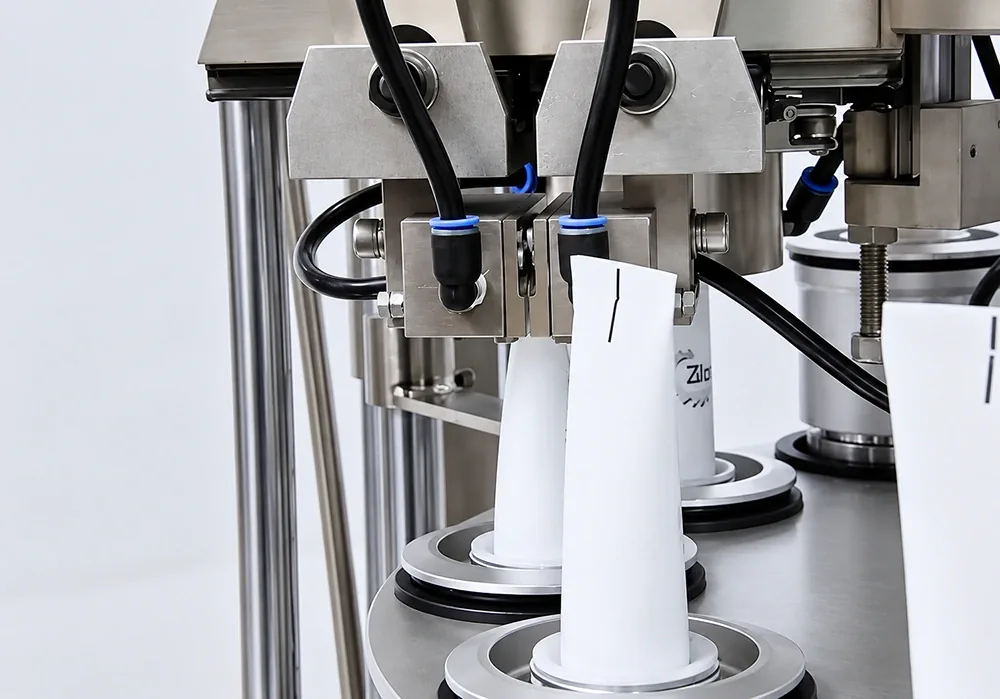
Colour mark registration
A photoelectric sensor finds the black mark on the tube and the nest rotates it into position. Every tube is crimped in the same pose, so the seal does not drift sideways.
Format change without dismantling
The adjustment units are on the outside and carry digital readouts: the mark-sensor arm, the height of the sealing unit and the position of the tube rack are set from outside, by scale and on the screen.
02 · Технические параметры
Specifications of the rotary automatic machine
The values below come from the manufacturer's technical documentation. The tube filling machine runs in one of four dosing ranges: the fill size is selected to match the task, not the other way round.
| Parameter | Value |
|---|---|
| Machine type | Rotary automatic machine for filling and sealing flexible tubes |
| Dosing volume | 2–5 / 5–30 / 10–140 / 30–300 ml (four ranges, selected per task) |
| Dosing accuracy | ≤ ±1% |
| Output | 60–80 tubes/min (depends on tube format, volume and viscosity) |
| Tube diameter | Φ10–60 mm; other diameters available |
| Tube length | 45–250 mm; other lengths available |
| Tube material | Plastic, laminated and aluminium |
| Compressed air | 0.6–0.8 MPa |
| Voltage and power | 380 V / 5 kW (heat sealing — 3.3 kW) |
| Overall dimensions | 2500 × 1200 × 2400 mm (L × W × H) |
| Machine weight | about 1500 kg |
The model, drive type and option list are fixed in the specification once the volume, material and tube format are agreed.
03 · Рабочий цикл
How the cycle runs: nine operations
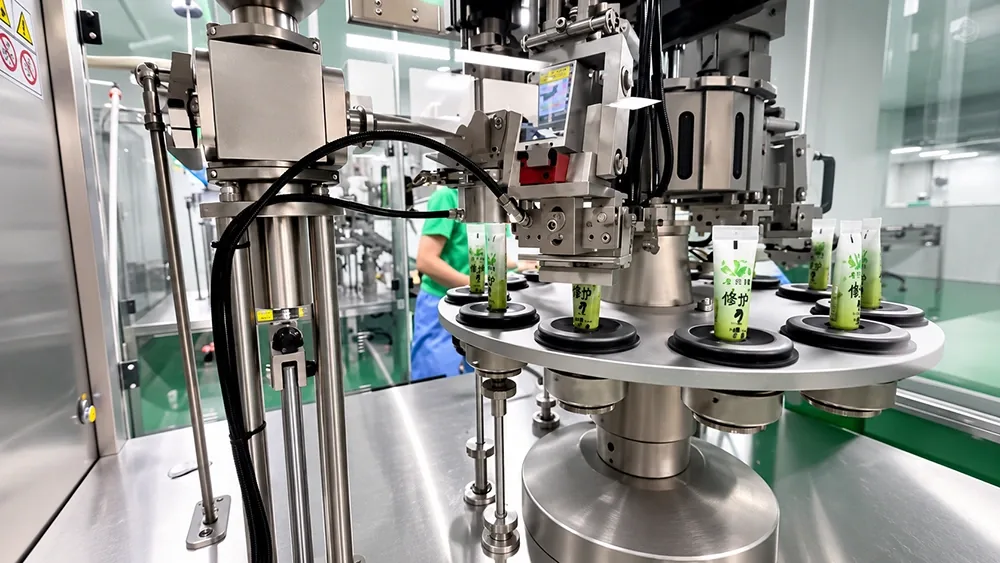
The indexing table moves the tube from one station to the next. While the tube sits in its nest, one operation is carried out — so the machine never stops for handling.
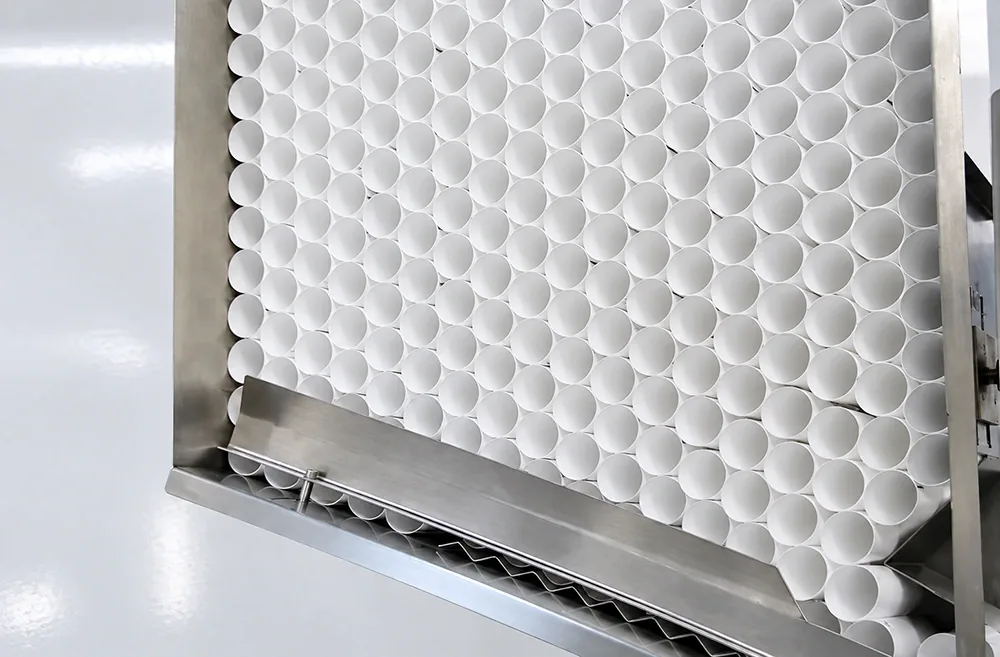
- 1Feeding the empty tube Empty tubes are loaded into an inclined hopper: the feeding unit aligns their direction and the lower section releases them one by one.
- 2Positioning in the nest A horizontal tube is turned 90° and clamped into its nest by a pneumatic cylinder — from there it travels with the indexing table.
- 3Registration against the mark A photoelectric sensor finds the black mark and the nest brings the tube to the required position. The setting is made with an adjusting screw carrying a digital readout.
- 4Inert gas filling (optional) Nitrogen is fed into the tube: it displaces oxygen and slows product oxidation. A sensor detects the tube direction — with a reversed tube the machine will not start.
- 5Filling Product travels from the conical hopper through a three-way valve to a piston dosing pump. The nozzle descends to the bottom of the tube, so the gas stays above the product.
- 6Tail heating The inner wall of the tail is heated by a unit with a digital temperature controller — the operator sets the temperature for the tube film.
- 7Crimping Two patterned jaws squeeze the tail. Optionally the date and batch number are embossed at the same time. The unit height is set by a handwheel with a scale to match the tube length.
- 8Tail trimming A trimming knife removes the remainder after sealing; the waste drops into a collection box under the machine.
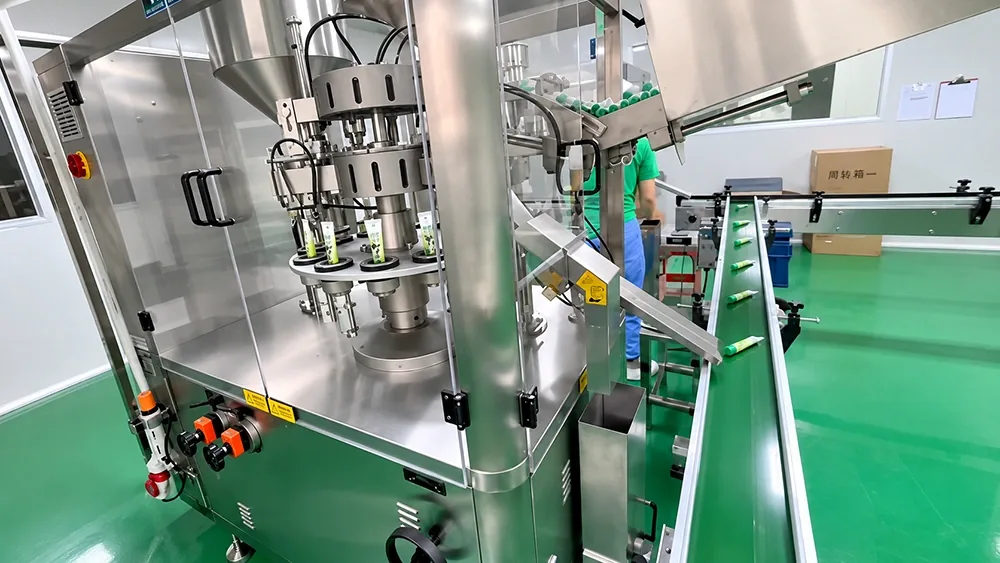
- 9Discharge An ejector pushes the finished tube out of the nest and it slides down an inclined chute onto the conveyor. Two machines can run in parallel feeding one conveyor.
04 · Конструкция
What the machine is made of
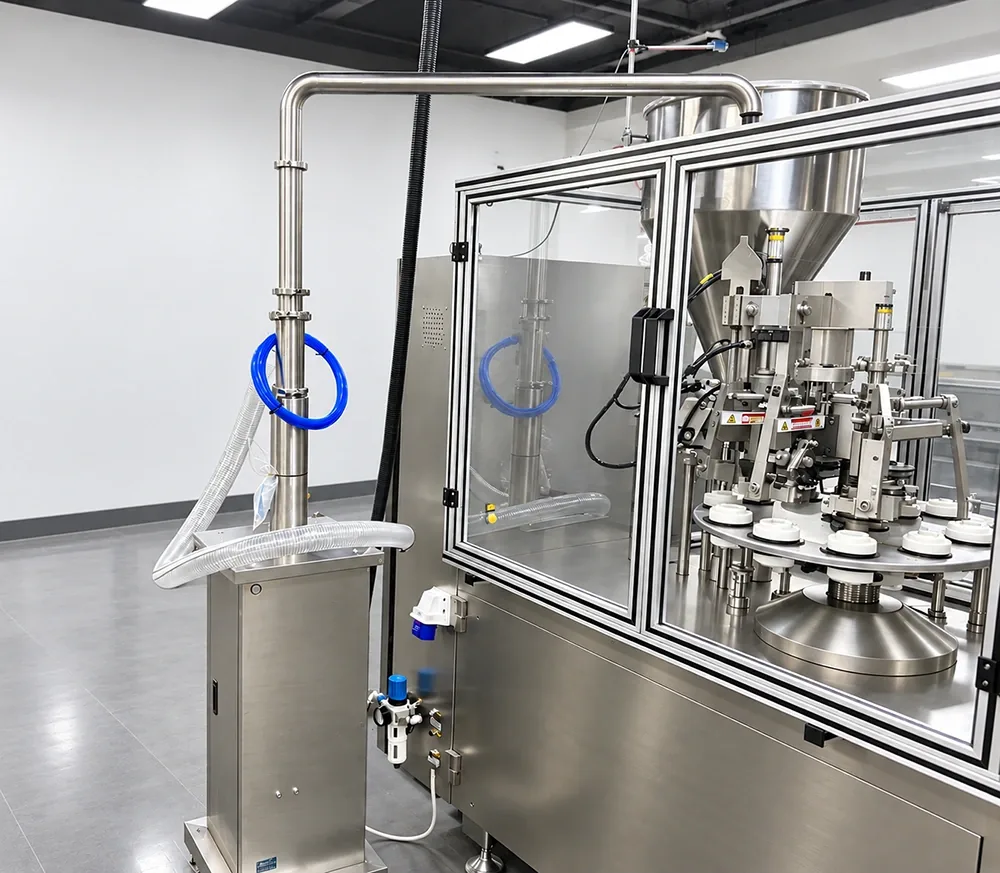
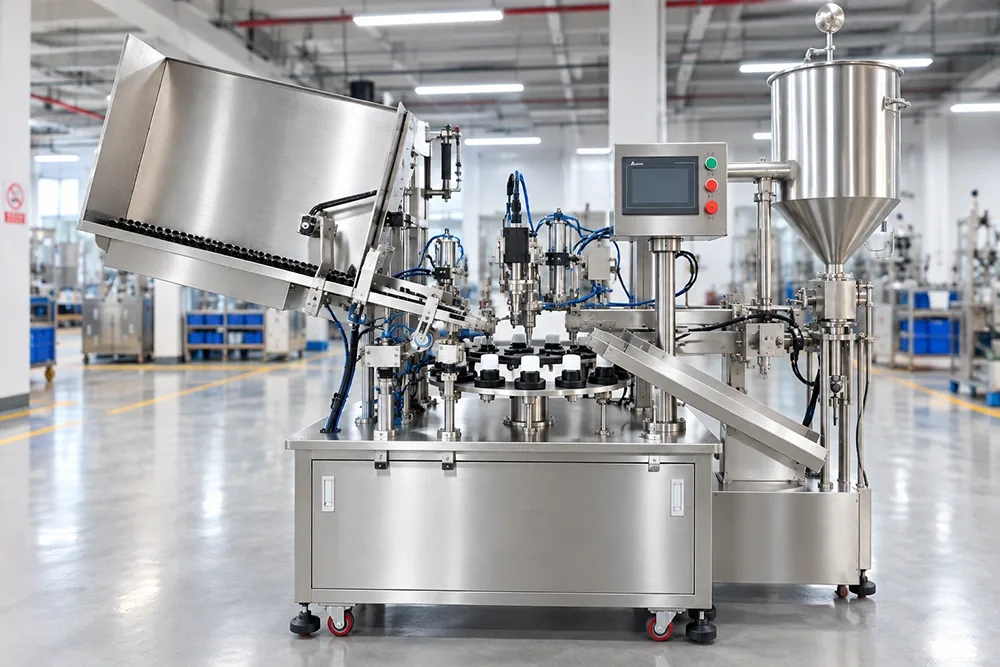
The frame and every part in contact with the product are food-grade 304 stainless steel. A metal guard with a transparent door stops the machine when opened. Tube sealing equipment in this arrangement is built for continuous work on the shop floor.
Inclined loading hopper
Empty tubes are loaded in batches, aligned and fed one by one. The rack is adjusted in height, front-to-back and by the side stops.
Pneumatics and servo drive
Nest lifting, feeding and transfer run on compressed air, with servo drives on the adjustable axes. Pressure and frequency are brought out to the panel.
Control cabinet
The touch panel sets the dosing volume, rotation speed, sealing temperature and coding parameters. A three-colour indicator shows the mode, with the emergency stop next to it.
05 · Применение
What is filled on this machine
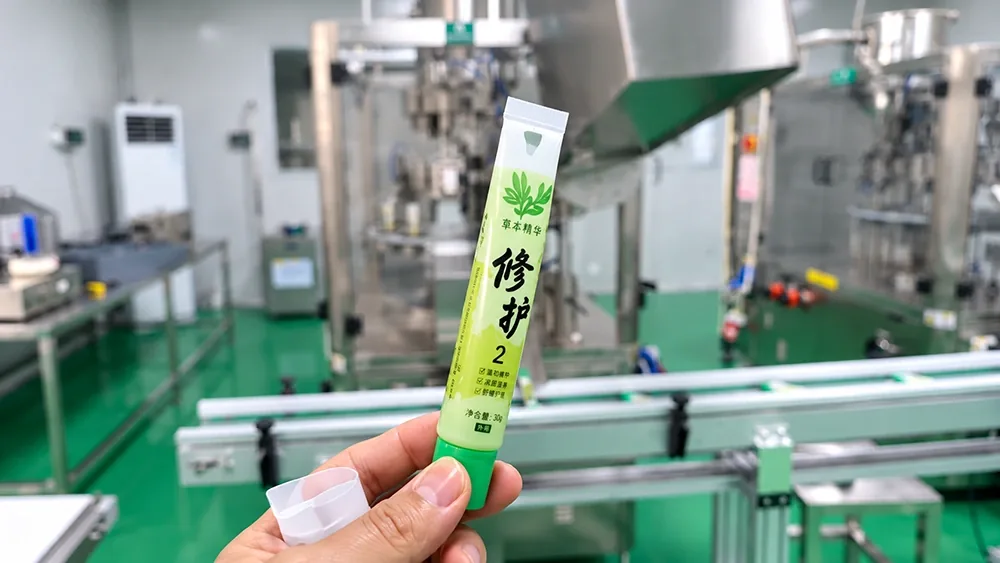
The machine is built for liquid, paste and gel products. Below are the industries where a flexible tube is the primary pack.
Cosmetics
Often requires inert gas filling and a coded date with the batch number.
Pharmaceuticals
The construction meets GMP requirements for hygienic production.
Food industry
For pastes with particles, a suitable dosing unit arrangement is selected.
06 · Подбор оборудования
What to prepare before the calculation
The exact configuration and price of the tube filling machine are settled once the inputs are agreed. Below are the parameters we ask the customer for — the engineer calculates the line from them.
01The tube
Material (plastic, laminated, aluminium), diameter Φ, length, whether formats change over time, and how many product changes per shift.
02The product
Name, viscosity, presence of particles, fibres, flammable or explosive components — these decide the dosing unit type.
03Volume and accuracy
Which fill range is needed, whether one machine runs several volumes, and what dosing accuracy is acceptable.
04Operating mode
Shifts per day, planned load, whether two machines run in parallel on one conveyor, and whether date and batch coding is needed.
05Workshop conditions
Voltage, available compressed air, required floor load, room cleanliness, and cleaning requirements.
06Delivery and service
Whether installation and commissioning on site are needed, operator training, spare parts scope and the delivery date.
What is not covered by the documentation
Noise level, cleaning programme and duration, changeover time between tube formats, energy consumption per thousand tubes, sealing temperature range, number and height of code characters, certificate numbers, the actual ramp-up curve, spare parts list and warranty period are not fixed in the source material and are clarified on request.
07 · Вопросы
Common questions about tube sealing
How is the tube tail sealed: what does the tube sealer depend on?
The tube sealer works in two operations: the tail is heated from the inside and squeezed between two patterned jaws. The ribs give a dense, tidy seal. The unit height is reset to the new tube length after every format change.
How are the jaws changed?
The sealing unit has four screws: two hold the jaws themselves, two hold the clamping plates. Loosen the two jaw screws, take the old jaws out, fit the new ones with the pattern facing inward and tighten again.
Is air injected into the tube?
It is an option. When enabled, nitrogen is fed into the tube: it displaces oxygen, slows oxidation and aerobic microbial growth and extends shelf life. The station also checks tube direction and will not run the cycle with a reversed tube.
How is the colour-mark sensor set?
The sensor reads the black mark and turns the nest so the tube sits in a consistent pose. The height of the sensor arm is set by a handwheel with a digital readout: loosen the two screws, move the arm, then lock them again.
What happens when the tube format changes?
Four units need resetting: the loading rack, the sensor arm, the sealing unit and, where required, the dosing program. All of them are on the outside and are adjusted without dismantling the machine.
What is the real output?
60–80 tubes/min is the calculated figure. The actual output depends on tube format, volume, viscosity and operating mode, and is confirmed on samples of your product.
Calculation request
We will calculate the configuration for your tube
Send the tube material and format, the volume and the product viscosity — the engineer will propose a configuration, a line layout and a cost calculation with a commercial offer.
A calculation based on your inputs. Serial production in China, delivery and commissioning.