
CODAPAK
A technical solution for filling sauce into spouted doypacks
Three project sections for filling thick sauce into ready-made doypack pouches: pouch feed replenishment, positioning on a rotary table, filling, capping, and transfer to an external packaging section.
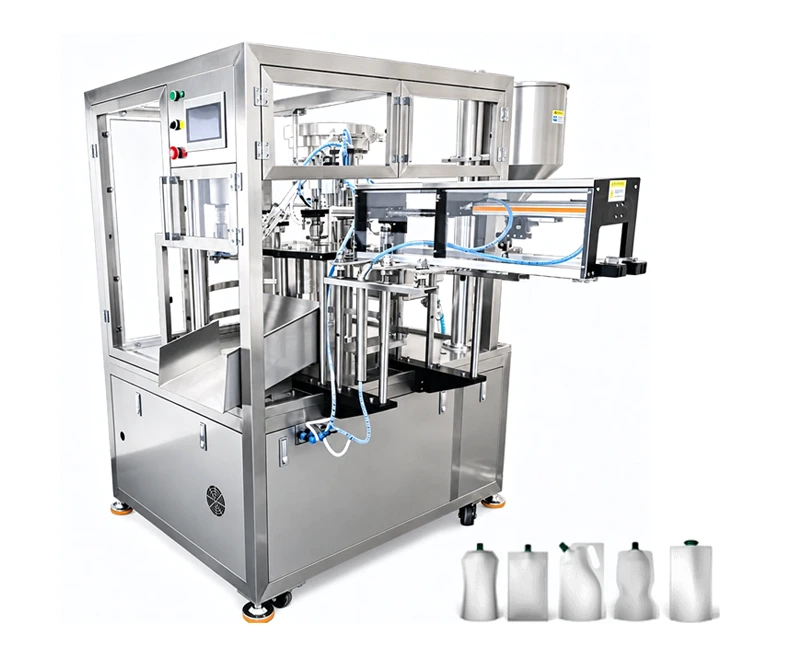
For the production of sauce, ketchup, or another thick food product in ready-made spouted doypacks, not only a filling machine is required, but also a coordinated chain of feeding, positioning, dosing, capping, and transfer of the product onward. SPfill is considered the central section of this chain: the pouch enters a rotary table, receives a portion of product and a cap, and exits to the next section. External product supply, pouch stock, and subsequent packing into boxes must be designed separately and verified against actual materials.
Fit conditions
- 01
- The product belongs to liquid, paste-like, or viscous sauces; actual viscosity, temperature, and required volume must be confirmed before selecting the pump and feed mode.
- 02
- Ready-made stand-up pouches with spout are used, compatible with rotary table pockets; width, height, spout position and cap type require verification with samples.
- 03
- The cycle should include automatic pouch feeding and securing, dosing, cap placement, screw capping, and discharge; the external conveyor and the sorting and cartoning section are coordinated as separate interfaces.
- 04
- The site provides 220 V, 50 Hz power, space for loading pouches, product feeding, finished pouch discharge, and safe maintenance.
Process and handoff
- 01
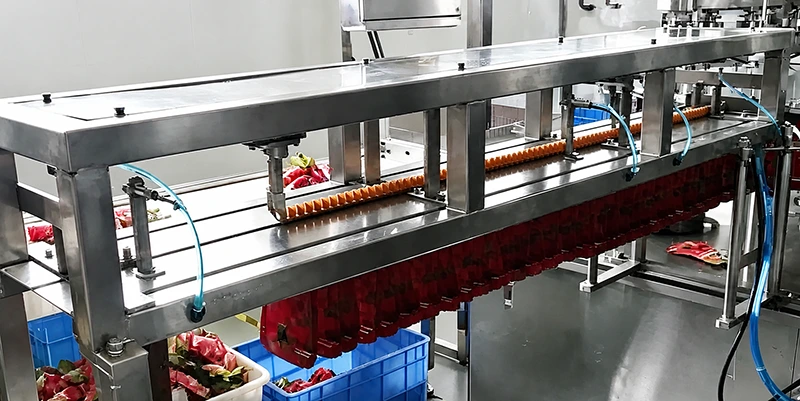
The operator loads empty pouches in batches into the hanging zone. The automatic feeding mechanism separates a pouch and transfers it to a rotary table pocket for positioning.
- 02
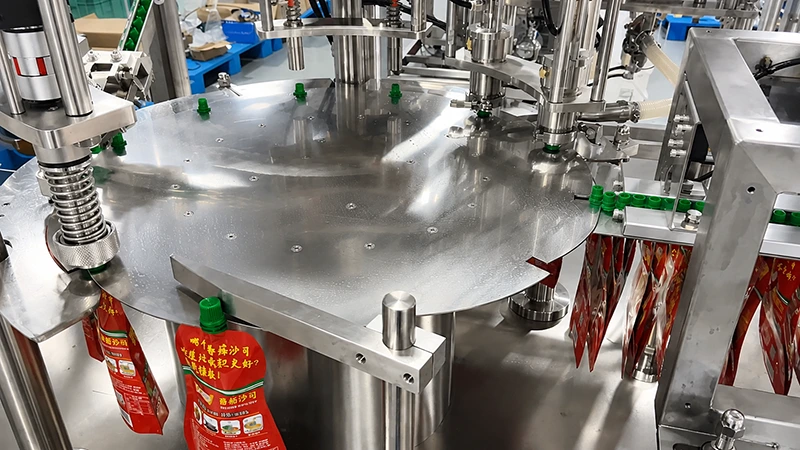
The rotary table moves intermittently: the pouch passes through the filling station, where the pump supplies product from the hopper through piping and dosing heads. A photoelectric sensor permits filling only when a pouch is present.
- 03
After filling, when equipped as specified, the spout is cleaned, then the cap is fed along a guide and placed on the spout. The screw capping unit tightens the cap, after which the discharge mechanism transfers the finished pouch to the next external section.
1. Pouch feeding and replenishment design
It is convenient to consider feeding as a separate first design: the stock of finished pouches is replenished in batches, then an automatic mechanism feeds them one by one to the table pockets. Here the pouch stiffness, spout position, suspension geometry, and grip stability are checked. A large stock of pouches, external product feeding, and cap transport should not be considered automatically included in the SPfill standard: the scope of supply is fixed after checking samples and the site layout.
2. Design of the central filling and capping cycle
The second design is synchronization of dosing with the intermittent rotation of the table. The hopper serves as an intermediate stock; depending on the product, a piston or rotary pump is considered, and heating and mixing can be options. After filling, cap placement and screw capping are performed. A photoelectric sensor implements the principle of 'no pouch — no filling', but the dose accuracy, tightening torque, and the need to clean the spout must be confirmed on the specific pouch, cap, and product.
3. Design of discharge and external packaging
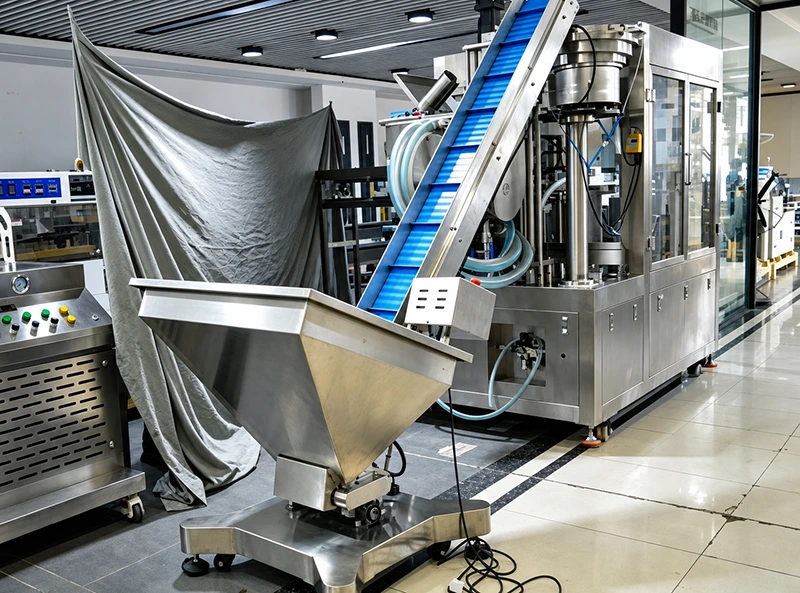
The third design begins after screw capping: a mechanism moves the finished pouch from the pocket onto an external conveyor or receiving table. Visual inspection, accumulation, organizing, and packing into boxes are then planned separately. SPfill should not be described as a complete line from raw material to box without coordinating these units. At the project meeting, the outfeed direction, transfer height, accumulation rate, leak testing requirements, and method of manual or automatic packing must be determined.
Points to confirm
- 01
- The pouch, spout, or cap may not match the pocket, guide, or capping unit; this is checked with a set of real samples.
- 02
- The viscosity and temperature of the sauce affect the choice of pump, heating, mixing, dose volume, and actual operating rate.
- 03
- Cap feeding, the conveyor after discharge, and packing into boxes may require separate machines, space, and communication signals.
- 04
- The configurations shown with different numbers of heads cannot be selected without confirming the target volume, rate, and specific configuration.
Solution validation inputs
- 01
- Samples of an empty spouted doypack pouch, cap, and a drawing or dimension table.
- 02
- Product sample with viscosity, feed temperature, and required volume per pouch.
- 03
- Target rate, shift plan, allowable dosing error, and cap tightening requirements.
- 04
- Diagram of external product supply, pouch replenishment, cap feeding, and transfer of the finished pouch.
- 05
- Site data: power supply 220 V 50 Hz, available area, transfer height, aisles, grounding, and service conditions.
- 06
- Requirements for cleaning the spout, marking, leak testing, and subsequent placing into boxes.
Application boundary
SPfill is described here as a central automated area for finished spouted bags: bag infeed, positioning on a rotary table, dosing, placement and capping, outfeed. External operations — product preparation and feeding, replenishment of bag stock, separate cap feeding, conveyor, inspection, and sorting and boxing — are not considered standard without separate agreement. Bag, cap, product, and selected configuration parameters must be verified before finalizing the project; this material is not a description of an implemented customer facility.
Check the three SPfill interfaces
Provide the bag and cap dimensions, sauce properties, target volume, and the layout of the areas before and after the machine — based on this data, the scope of verification and the boundaries of the solution can be determined.