
Project resource
SPfill spouted-pouch filling and capping line
Define the SPfill process and interfaces from pouch feeding and positioning through dosing, cap placement, screw capping and discharge.
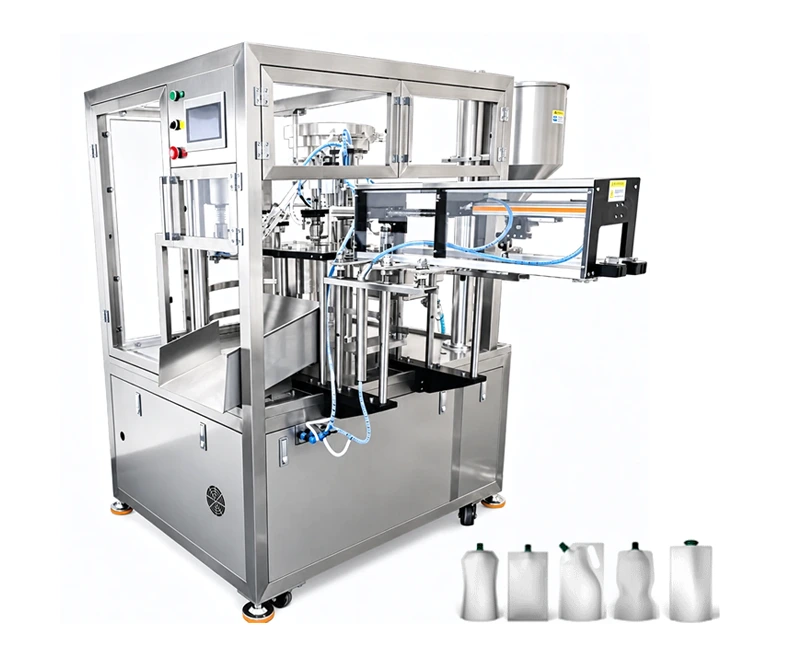
Solution scenario
Define the SPfill process and interfaces from pouch feeding and positioning through dosing, cap placement, screw capping and discharge.
Fit conditions
The product should be a liquid or paste whose viscosity, temperature, and cleaning requirements can be tested before final configuration.
The package should be a spouted stand-up pouch with confirmed pouch dimensions, spout position, cap specification, and positioning method.
The required fill volume should be checked against the documented 30–2000 ml range and the actual product behavior.
The target output should be reviewed against the documented 30–60 pouches per minute, because viscosity, fill volume, pouch format, and station configuration affect the result.
The site should provide the documented 220V 50Hz supply, grounding, floor support, leveling space, pouch loading area, and finished-product discharge area.
Process and handoff sequence
- 1
Confirm the product, pouch, cap, fill volume, output target, utility conditions, and optional modules before setting the line boundary.
- 2
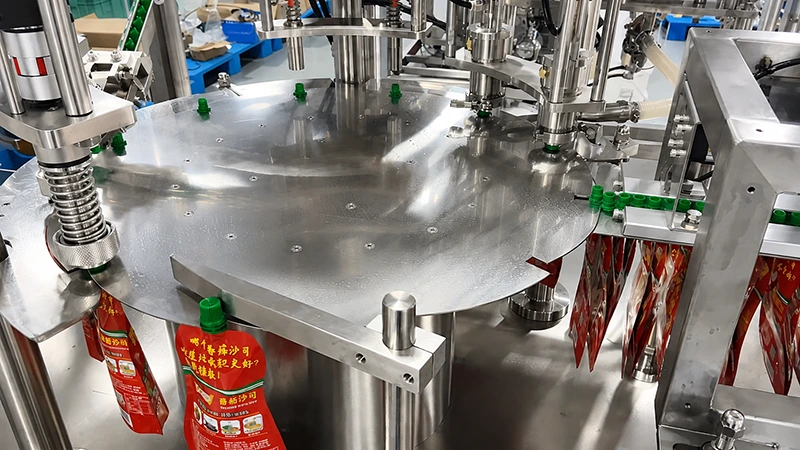
Introduce empty spouted pouches to the feeding mechanism; the machine separates and transfers individual pouches to the rotary worktable positioning points.
- 3
Use position and photoelectric checks to permit filling only when a pouch is present and the spout is in the expected position.
- 4
Transfer the product from the hopper through the selected pump and filling heads; hopper heating or agitation can be reviewed as an option for the material.
- 5
Organize cap conveying, cap placement, screw capping, and finished-pouch discharge, then define the interface with the downstream conveyor or packing operation.
From Empty Pouch to Capped Product
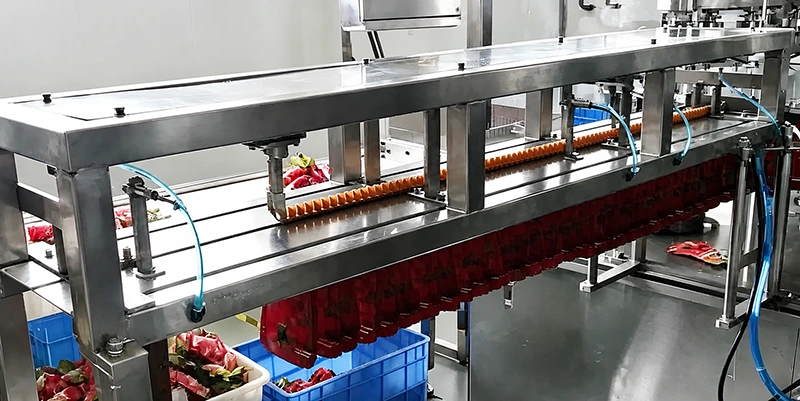
SPfill is described as the core machine of a pouch filling line rather than an isolated filling head. Its rotary worktable coordinates pouch feeding, positioning, filling, cap placement, screw capping, and discharge in a compact sequence.
The line boundary should be finalized around the actual pouch format, product behavior, cap interface, and downstream connection instead of assuming one universal setup.
Match Dosing to the Product
The documented product range covers liquids and pastes, with a 30–2000 ml fill range. Tomato sauce, tomato paste, and sauce base are the clearest stated food applications, while the actual viscosity and fill behavior still require testing.
A hopper, pump, filling heads, and product-contact path form the dosing interface. Heating, agitation, pump type, and contact-material details should be selected or confirmed from the product trial and final BOM rather than assumed.
Control Points for a Repeatable Process
The documented control functions include rotary-table speed, fill volume, cleaning, reset, and operating-state feedback through the electrical control and HMI system.
Photoelectric detection is a process safeguard: the documented logic stops filling when a pouch is absent. The engineering review should still test sensor response, pouch seating, and the cap-position interface with actual packaging.
Site and Acceptance Readiness
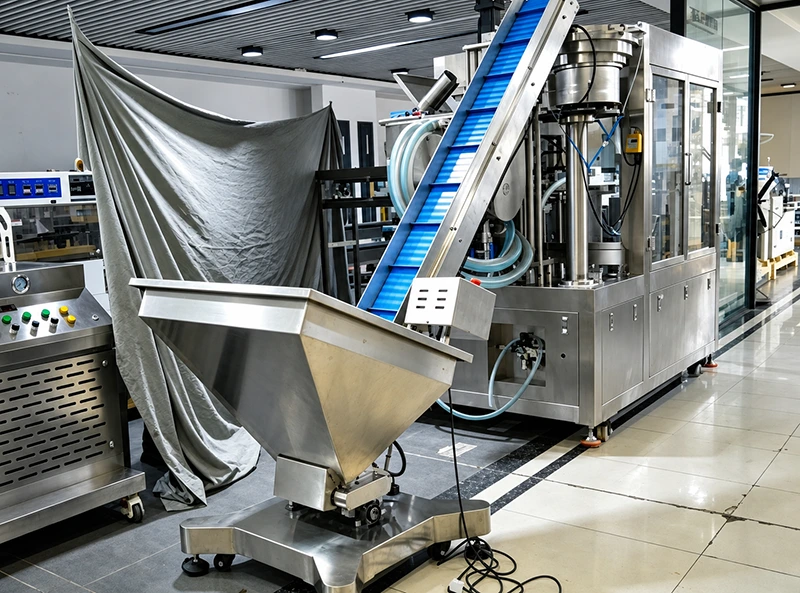
Before installation, review the 220V 50Hz supply, grounding, floor support, leveling, operator space, pouch loading, and finished-product discharge. Optional heating, agitation, cleaning, or coding functions may require additional interface and space checks.
Acceptance should use the real product and packaging to check fill-volume stability, pouch seating, no-pouch/no-fill behavior, cap engagement, seal result, cleaning access, and the downstream handoff.
Risks to close early
Actual speed depends on product viscosity, fill volume, pouch format, and station configuration; the documented 30–60 pouches per minute is not a guaranteed result for every product.
Pouch dimensions, spout position, cap geometry, and seating method may require format parts or additional engineering confirmation.
Heating, agitation, spout cleaning, and coding are options or extensions and should not be included without confirming the product, utility, space, and control interfaces.
The standard specification lists 2, 4, 8, 10, or 12 filling heads, while video materials show a 6-head example; the applicable head count must be confirmed.
The source table records a questionable 60–3360 mm width for one pouch type; this value must be checked against the original technical source before engineering release.
Contact-material details for the hopper, pump, filling heads, and capping area are not confirmed at BOM level and require final documentation review.
Inputs to validate the solution
A representative sample of the actual product, including viscosity and temperature conditions for the intended process.
Production pouch samples with confirmed dimensions, spout location, pouch material, and matching caps.
Target fill volume, batch or shift output, and the required filling-head configuration for the engineering trial.
Test results for fill-volume stability, pouch seating, photoelectric no-pouch/no-fill response, and cap placement and screw-capping behavior.
Site information covering 220V 50Hz power, grounding, floor and leveling conditions, available footprint, operator access, and upstream or downstream interfaces.
A documented acceptance matrix covering fill volume, capping and seal result, cleaning access, optional modules, and handoff to the next operation.
Prepare the Engineering Review
Send the product, pouch, cap, fill-volume, output, and site inputs so the SPfill configuration can be reviewed against real process conditions.