
Project resource
SPfill: operating checks and acceptance for spouted pouches
Define sample acceptance for pouch positioning, no-pouch/no-fill response, capping, cleaning access and finished-pouch transfer.
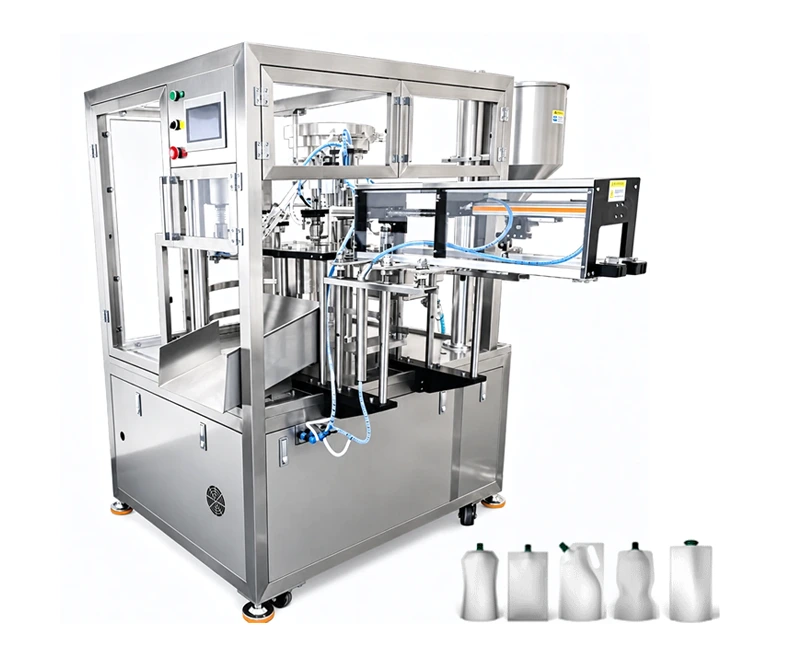
Solution scenario
Define sample acceptance for pouch positioning, no-pouch/no-fill response, capping, cleaning access and finished-pouch transfer.
Fit conditions
The product is a liquid or viscous food material, with ketchup, tomato paste, and sauce bases identified as direct application examples.
The package is a premade spouted stand-up pouch, and the pouch, spout, and cap dimensions can be provided for positioning and closing checks.
The required process includes automatic pouch feeding, a rotary worktable, filling, cap handling, screw capping, and discharge rather than a filling-only station.
The installation can provide the stated 220V 50Hz power condition, floor space, leveling, and downstream access for the finished-pouch transfer.
Process and handoff sequence
- 1
Load empty spouted pouches into the feeding area; the mechanism separates individual pouches and transfers them to the rotary table.
- 2
Position the pouch at the worktable fixture and use photoelectric detection to confirm pouch presence before filling.
- 3
Transfer the material from the hopper through the selected pump and filling heads into the pouch; hopper heating or agitation is an optional process condition.
- 4
If required by the configuration, clean the spout area before the cap is supplied and placed onto the pouch.
- 5
Move the pouch through the screw-capping station, where the cap and spout interface must be matched to the selected package specification.
- 6
Discharge the filled and closed pouch to the downstream conveyor or next packaging operation.
Control, detection, and daily operation
The HMI supports adjustment of rotary-table speed, fill volume, cleaning of residual material, and reset functions, while the photoelectric system provides the no-pouch-no-fill interlock described in the product data.
Before operation, the team should confirm pouch orientation, spout position, cap supply, and the relationship between the rotary-table fixture and the filling head.
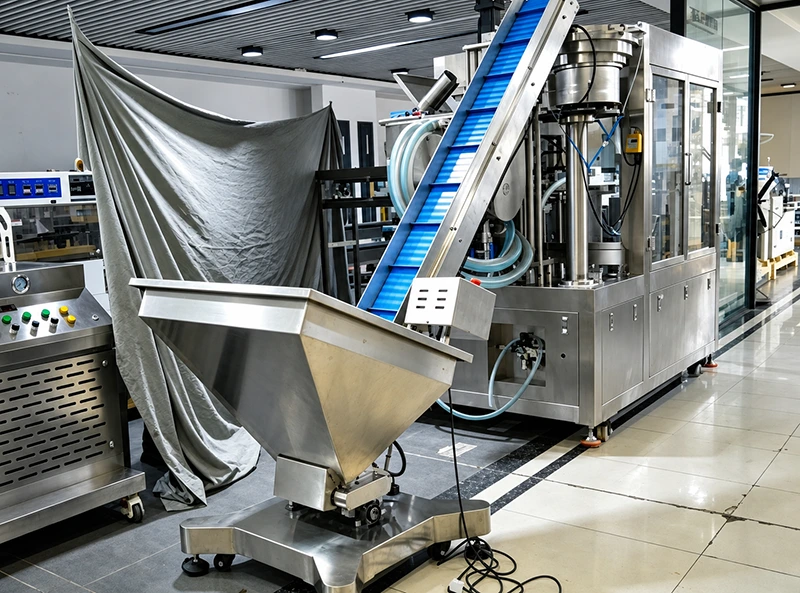
Cleaning of the hopper, product lines, filling heads, and spout contact area, together with inspection of sensors, guides, fixtures, and the capping mechanism, is part of the operating boundary.
Validation before configuration approval
Configuration approval should follow a review of the product, pouch and cap samples, target fill volume, production rhythm, selected filling-head count, site utilities, and connections to the next operation.
Acceptance should define how fill-volume stability, sealing effect, pouch appearance, and discharge transfer are checked; the available material does not establish a customer-specific acceptance result.
Risks to close early
Product viscosity and fill volume affect the achievable production rate; the stated 30–60 pouches per minute is a reference range, not a guaranteed result for every material or package.
Pouch dimensions, spout position, cap geometry, and fixture matching can affect feeding, filling alignment, and capping stability, so samples and drawings must be checked.
The source records different filling-head counts between the specification and video examples, and the listed slanted-pouch dimension contains a value requiring secondary confirmation.
Optional heating, agitation, spout cleaning, coding, and conveyor interfaces can change the space, utility, and control requirements of the line.
Inputs to validate the solution
Product identity, viscosity range, temperature condition, and whether the material is ketchup, tomato paste, sauce base, or another viscous food product.
Pouch samples or drawings covering width, height, spout position, pouch construction, cap type, and the closing interface.
Required fill volume, acceptable fill-volume deviation, and planned production rhythm or shift output.
Decision on hopper heating, agitation, spout cleaning, laser coding, line conveyors, and the related cleaning and maintenance procedure.
Acceptance method for filling stability, capping and sealing performance, pouch appearance, no-pouch-no-fill behavior, and finished-pouch transfer.
Review your pouch and filling configuration
Send the product, pouch, cap, volume, output, and site information so the SPfill process interface can be reviewed before configuration approval.